Venus May Have Devoured Its Moon
One of the great mysteries in astronomy has been why Venus has no moon. Now a new theory provides a simple answer: It might have been eaten.
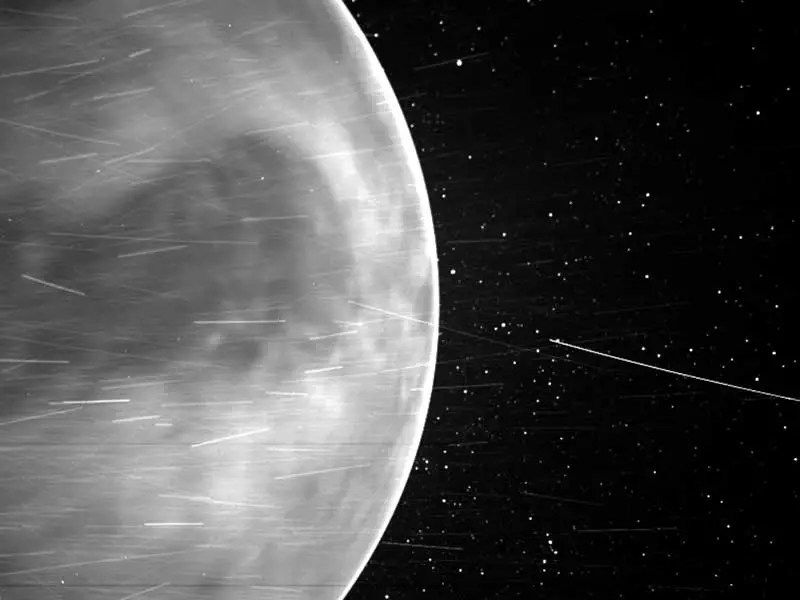
Recent research from the University of California, Riverside indicates that Venus may have consumed its moon rather than the moon being destroyed by an external collision. According to Steven Kane, the paper's lead author, Venus' slow rotation and gravitational pull were sufficient to pull the moon in and cause it to fragment over time.
This process would not require a catastrophic event to result in the moon's disappearance. Venus' slow rotation, taking 243 Earth days to complete one spin, is the slowest in our solar system, making it unique compared to Earth's faster rotation. The slow rotation, coupled with Venus' gravity, would cause the moon to spiral inward instead of being pushed away.
Computer simulations by Kane and his team revealed that under various conditions, including different rotation speeds and moon masses, the moon would eventually be swallowed by Venus. However, the study does not confirm that Venus once had a moon, as its surface is geologically young, indicating the loss of the top layer of rock.
If any remnants of a moon exist on Venus, they would likely be buried deep underground due to the planet's active geological processes. The moon's disappearance could provide insights into Venus' evolution, potentially influencing its habitability and the development of life. This finding suggests that planets with slower rotation speeds may be more prone to swallowing their moons, impacting the search for Earth-like exoplanets.
Written by urgent.news from Wired's reporting — not their text. Machine-written — may contain errors; check the original before relying on it.
Also reported by 1 other outlet
- Venus May Have Devoured Its Moon wired.com