APOD: 2026 September 24 – The Ghosts of Five Supernovas
APOD Science APOD APOD: 2026 September 24 –… Today’s APOD Archive Submissions Index Search Calendar RSS Education About Discuss APOD Astronomy Picture of the Day Discover the cosmos! Each day a different image or photograph of our fascinating universe is featured, along with a brief explanation written by a professional astronomer. OriginalAnnotated The Ghosts […]
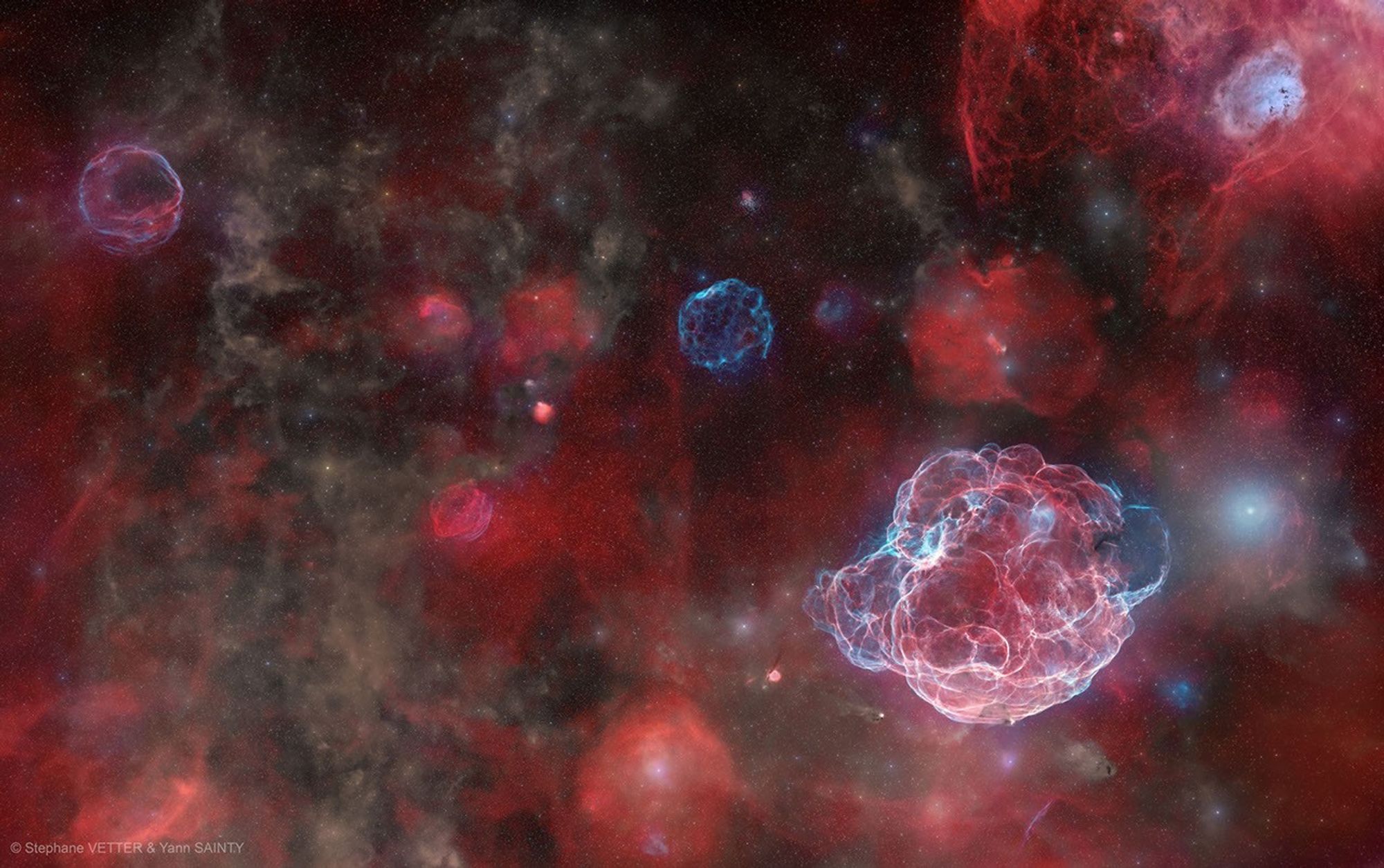
Today's Astronomy Picture of the Day showcases an extraordinary image captured at the Oukaïmeden Observatory in Morocco. Spanning an area equivalent to the size of a thousand full moons, it features a portion of the sky located in the constellation Auriga. The image reveals five distinct supernova remnants, each haunting the celestial landscape.
From left to right, the remnants are identified as G181.1+9.5, G182.4+4.3, G179.0+2.6, G180.0−1.7 (also known as the Spaghetti Nebula), and G178.2−4.2. These remnants, highlighted in the annotated version of the image, are accompanied by the open cluster M37 and the Tadpole Nebula.
The explosions responsible for these supernova remnants expanded into space, creating expanding shells of shocked gas and delicate filamentary structures. These structures are depicted in the image in red hues, representing hydrogen, and blue tones, representing oxygen. Each supernova explosion occurred independently, situated at varying distances up to several thousand light-years away from Earth and boasting ages that stretch out to tens of thousands of years.
In ancient times, early humans might have perceived these bright new stars as awe-inspiring phenomena, gradually fading away over the course of weeks or months as their remnants continued to evolve.
Written by urgent.news from NASA's reporting — not their text. Machine-written — may contain errors; check the original before relying on it.
This story
This is one outlet's version. Read the fullest account.
- APOD: 2026 September 24 – The Ghosts of Five Supernovas science.nasa.gov