APOD: 2026 September 24 – The Ghosts of Five Supernovas
The post APOD: 2026 September 24 – The Ghosts of Five Supernovas appeared first on NASA Science .
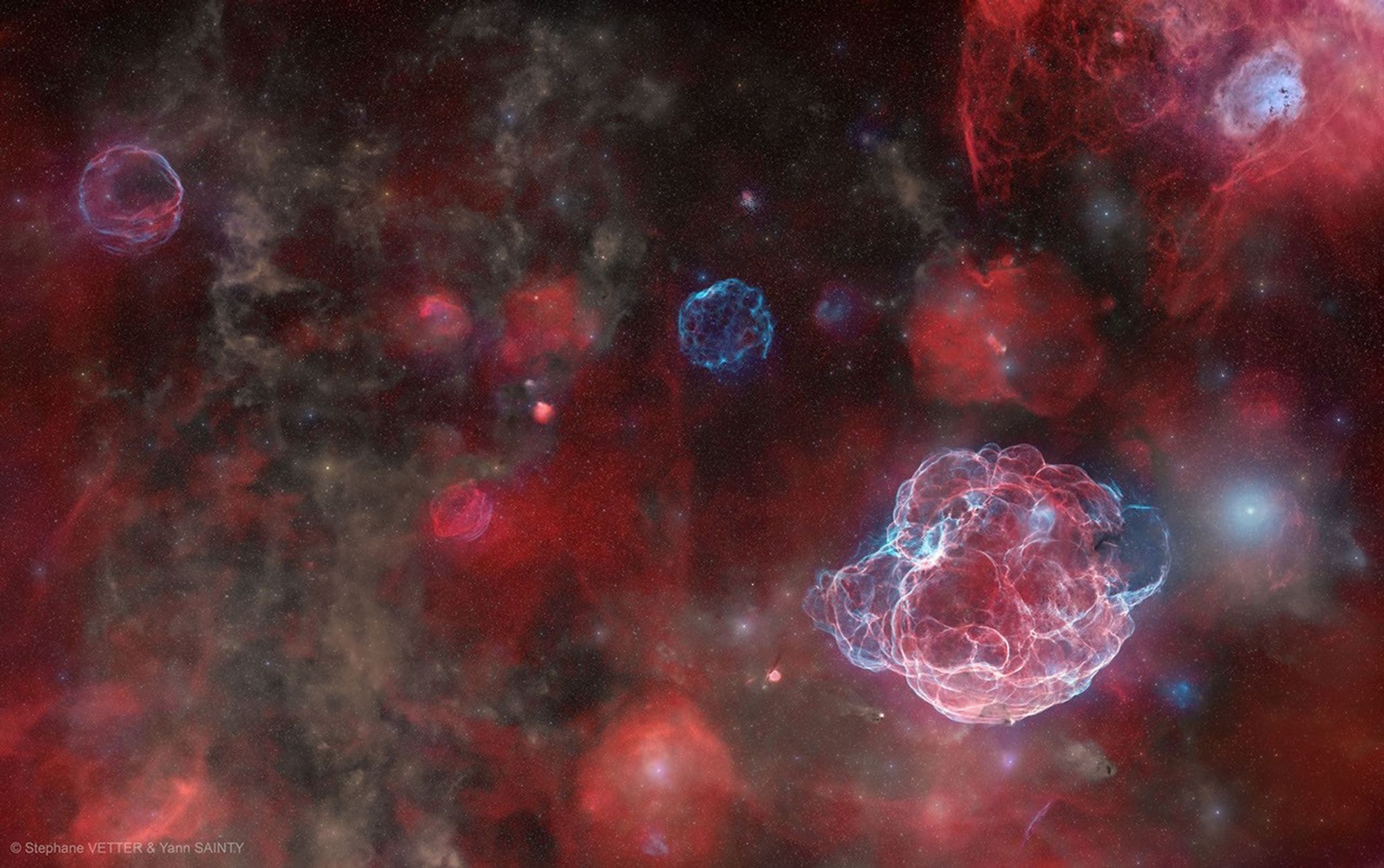
The intriguing image captured by the Oukaïmeden Observatory in Morocco reveals the ethereal remains of five supernovas, spread across an area as vast as one thousand full moons. The astrophotograph, captured using roughly 200 hours of observation, showcases the constellation Auriga in the night sky.
From left to right, the remnants of these ancient stellar explosions can be identified as G181.1+9.5, G182.4+4.3, G179.0+2.6, G180.0−1.7 (also known as Sh2-240, or the Spaghetti Nebula), and G178.2−4.2. Each of these supernova remnants is highlighted in an annotated version of the image, along with nearby open cluster M37 and the Tadpole Nebula.
As each supernova exploded, it propelled a growing shell of shocked gas and intricate filamentary structures into space. These remnants are composed of hydrogen (depicted in red) and oxygen (depicted in blue). The ancient stellar explosions occurred independently and are situated at varying distances, ranging up to several thousand light-years away from Earth. The estimated ages of these remnants span from a few thousand to tens of thousands of years.
In the annals of human history, it is conceivable that early civilizations may have mistaken these supernova remnants for bright new stars, only to observe them fade away over a period of weeks or months. However, it is worth noting that the email address for image submissions to APOD has been updated, and readers are directed to APOD Submissions for further information. Moreover, the main NASA website associated with APOD is undergoing a transition.
Written by urgent.news from NASA Science's reporting — not their text. Machine-written — may contain errors; check the original before relying on it.
Also reported by 1 other outlet
- APOD: 2026 September 24 – The Ghosts of Five Supernovas science.nasa.gov