Earth's Center of Mass Drifts Less Than We Thought
Earth's center of mass isn't stationary. It drifts seasonally and over the course of years. A new study measures this down to the scale of millimeters and finds the seasonal drift is smaller than we thought.
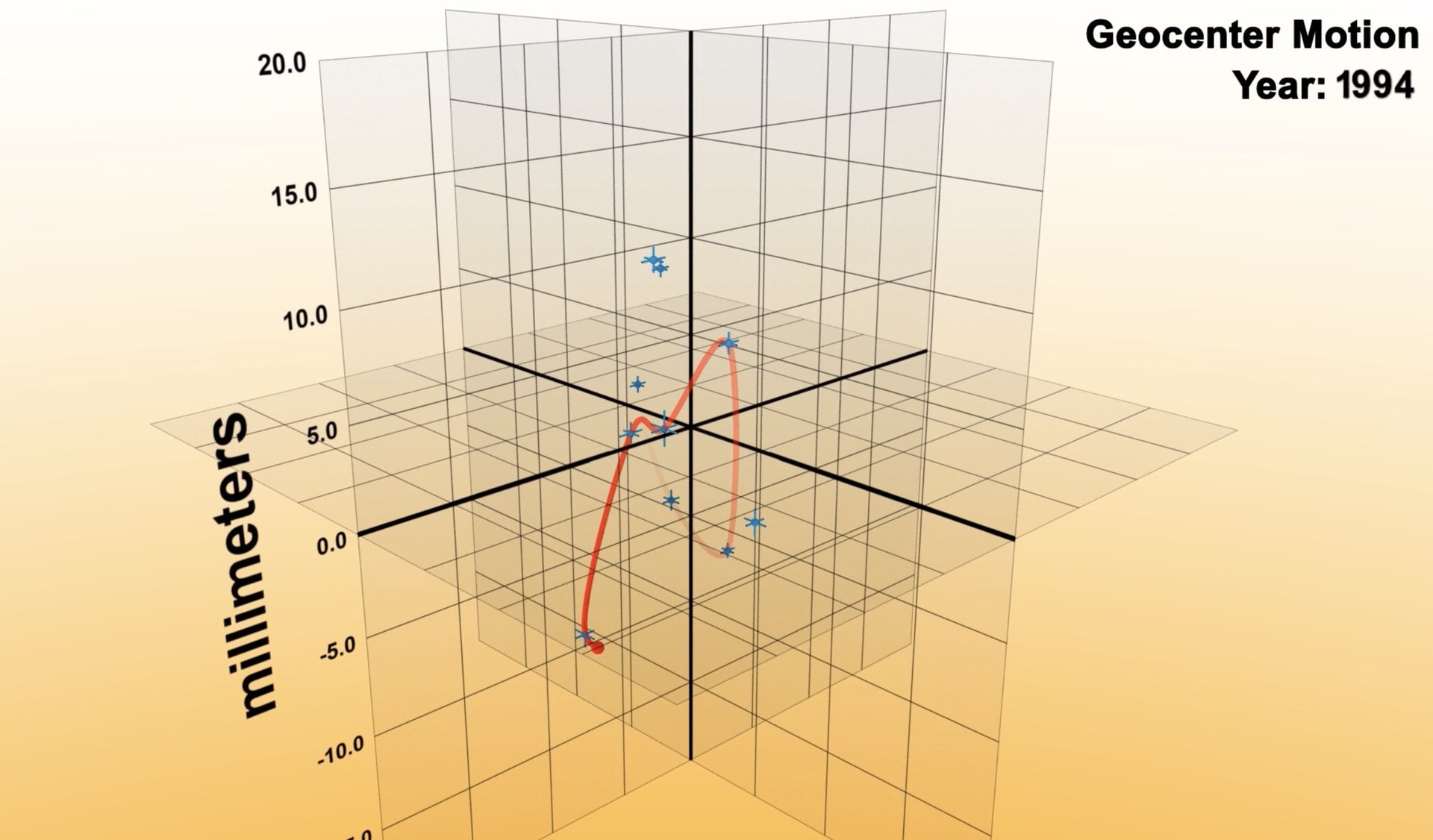
Determining the exact location of Earth's center of mass may seem straightforward, but it's not as simple as it appears. This precise point isn't just at the planet's core, contrary to simple intuition. Understanding Earth's center of mass to within millimeters is far from trivial, offering insights into our planet's dynamics. Accurately measuring Earth's center of mass demands a space-based observation approach.
Satellites naturally orbit around the actual center of Earth's mass. Even minor alterations in this center can lead to shifts in their orbital paths. Consequently, computational analysis of orbital trajectories is necessary. In the 1980s and 1990s, this was accomplished using LAGEOS satellites, which were spherical and covered in reflective panels to enable ground-based laser observatories to track their positions over time, allowing for determining the center of mass to within a centimeter.
However, this study refines accuracy by incorporating GPS data to account for subtle shifts in ground observatory locations and integrating data from numerous low-orbit satellites. Consequently, the uncertainty is now less than a millimeter. This finding aligns with certain expectations. The Earth isn't a static entity. During the Northern Hemisphere's winter, snow and ice accumulation in polar regions increase mass, while warming and cooling of oceans alter densities.
The Amazon's rainy season redistributes water to its delta. These changes cause Earth's center of mass to shift seasonally. The noteworthy discovery here is that this seasonal drift is smaller than previously anticipated. The research reveals a seasonal drift roughly half of earlier estimates, indicating that water and air movement between hemispheres is less extensive than assumed.
Additionally, the team observed longer-term shifts in the center of mass attributed to geological phenomena like volcanic activity and earthquakes. Such shifts can affect Earth's rotational speed. Precise measurements like these enhance our comprehension of geological changes and improve our positioning on Earth, impacting everything from transportation and shipping to the orbital drift of satellite constellations. Remarkably, we can pinpoint Earth's center with such accuracy.
Written by urgent.news from Universe Today's reporting — not their text. Machine-written — may contain errors; check the original before relying on it.