50 Years Ago, NASA Unveiled its First Space Shuttle
And “Star Trek” fans named it The post 50 Years Ago, NASA Unveiled its First Space Shuttle appeared first on Nautilus .
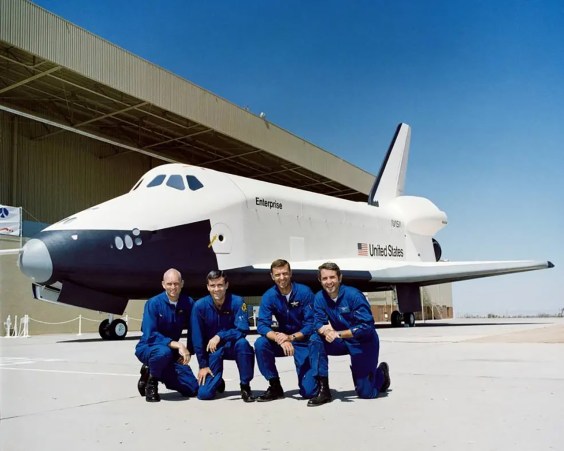
On September 17, 1976, NASA made a bold statement about its aspirations for space exploration by unveiling its first space shuttle at the Rockwell International manufacturing plant in Palmdale, California. The event drew attendees including Gene Roddenberry, the creator of Star Trek, and several cast members of the popular television show.
Around the time of the unveiling, an estimated 100,000 Star Trek fans had written to the White House, urging the shuttle be named the Enterprise after the spaceship commanded by Captain Kirk. President Gerald Ford granted their request, and the Enterprise was born. Originally, the shuttle was to be called Constitution, but Enterprise prevailed.
Despite being the pioneering shuttle, the OV-101—or Enterprise's technical designation—never ventured into space. Instead, it was used for test flights and diagnostic checks to inform the development of future shuttles. A total of five shuttles were eventually built, and Enterprise served as the initial test frame before being replaced by the Space Shuttle Challenger (OV-102).
Initially, Enterprise was attached to a Boeing 747 for its test flights, with the first independent flight occurring on August 12, 1977. Four more flights followed before Enterprise returned to the ground, completing its mission on October 26, 1977. The shuttle's most significant discovery during these tests was a control system issue known as Pilot-Induced Oscillation (PIO), which caused flight deviations to be over-corrected.
This problem was resolved for subsequent shuttles, starting with Columbia (OV-102), which launched in 1981. NASA's shuttle program lasted until 2011, when concerns over costs and safety—following two tragic disasters that claimed the lives of their crews—led to its retirement. Despite this, the shuttle program accomplished a great deal.
Over its three-decade lifespan, it carried hundreds of astronauts into orbit, deployed the Hubble Space Telescope (which later underwent repairs), sent probes to Jupiter and Venus, and contributed to the construction of the International Space Station. Enterprise's legacy lies in its pioneering work with reusable space technology, a concept that continues to inform modern space exploration.
Its story also serves as a testament to the enduring passion of Star Trek fans, who passionately advocated for the shuttle's name.
Written by urgent.news from Nautilus's reporting — not their text. Machine-written — may contain errors; check the original before relying on it.