Researchers Measure the Environment Where the First Supermassive Black Holes Formed
Scientists theorize that the rapid emergence of supermassive black holes (SMBHs) in the early Universe can be explained by the direct-collapse black hole (DCBH) scenario. In a recent study, astronomers investigated the potential host environments of DCBHs and found that this scenario is a plausible explanation for how the "seeds" of SMBH formed.
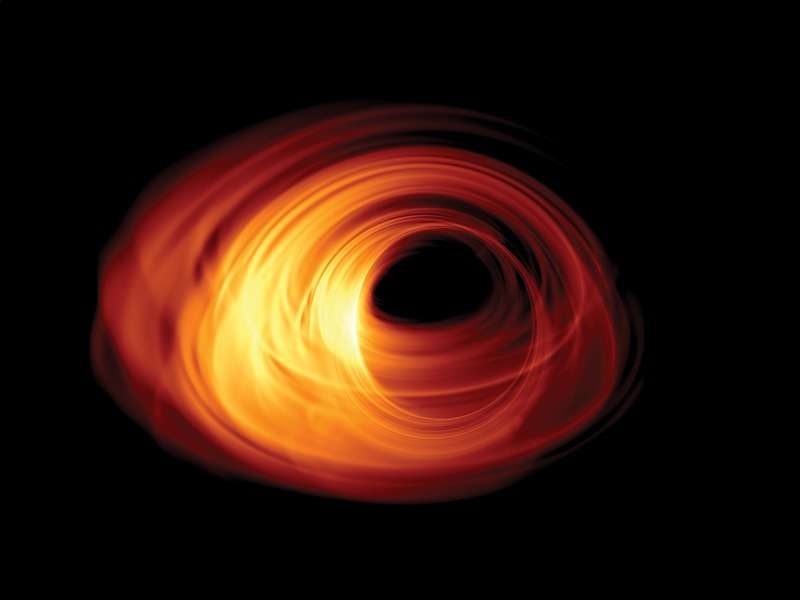
In the early universe, shortly after the Big Bang, researchers discovered an unexpected abundance of galaxies harboring what appeared to be the seeds of supermassive black holes. This finding challenged existing theories of black hole formation, which posited that stars collapsing at the end of their lives formed black holes that later merged to create supermassive black holes.
Consequently, astronomers began considering an alternative pathway called the Direct-Collapse Black Hole (DCBH) scenario, where massive cold gas clouds collapsed at the centers of early galaxies to form these black holes. However, the environments where DCBHs formed remained largely unknown. A team of international astronomers, led by Alessandro Trinca from the University of Edinburgh's Institute for Astronomy, explored this question by examining the role of Dark Matter (DM) mergers and regions of space with high concentrations of gas, dust, and stars (cosmic overdensities) as potential environments for DCBH formation.
The study, published in the Monthly Notices of the Royal Astronomical Society, employed high-resolution N-body simulations and semi-analytic models to trace the abundance, distribution, and environmental conditions of halos capable of forming DCBH seeds. The findings suggest that these massive black hole seeds could have formed as early as 13.64 billion years ago, less than 500 million years after the Big Bang, continuing until about 13.5 to 13.4 billion years ago.
This timeframe coincides with a period when metal enrichment of the intergalactic medium, caused by the explosions of the earliest Population III stars in supernovae, would have hindered further direct collapse episodes. The research provides a theoretical framework to investigate the conditions that favor the formation of heavy seeds and assess the role of direct collapse in the formation of supermassive black holes observed at extremely high redshifts.
The identification of a large population of quasar-companion AGN candidates in future surveys would serve as a strong indication that early massive black hole formation predominantly occurs in highly clustered, overdense environments.
Written by urgent.news from Universe Today's reporting — not their text. Machine-written — may contain errors; check the original before relying on it.