From QA Engineer to AI Validation Engineer: The Career Shift Nobody Saw Coming
Why AI systems are creating a new career path — and how QA engineers can lead it. The AI Validation Engineer role is emerging now.
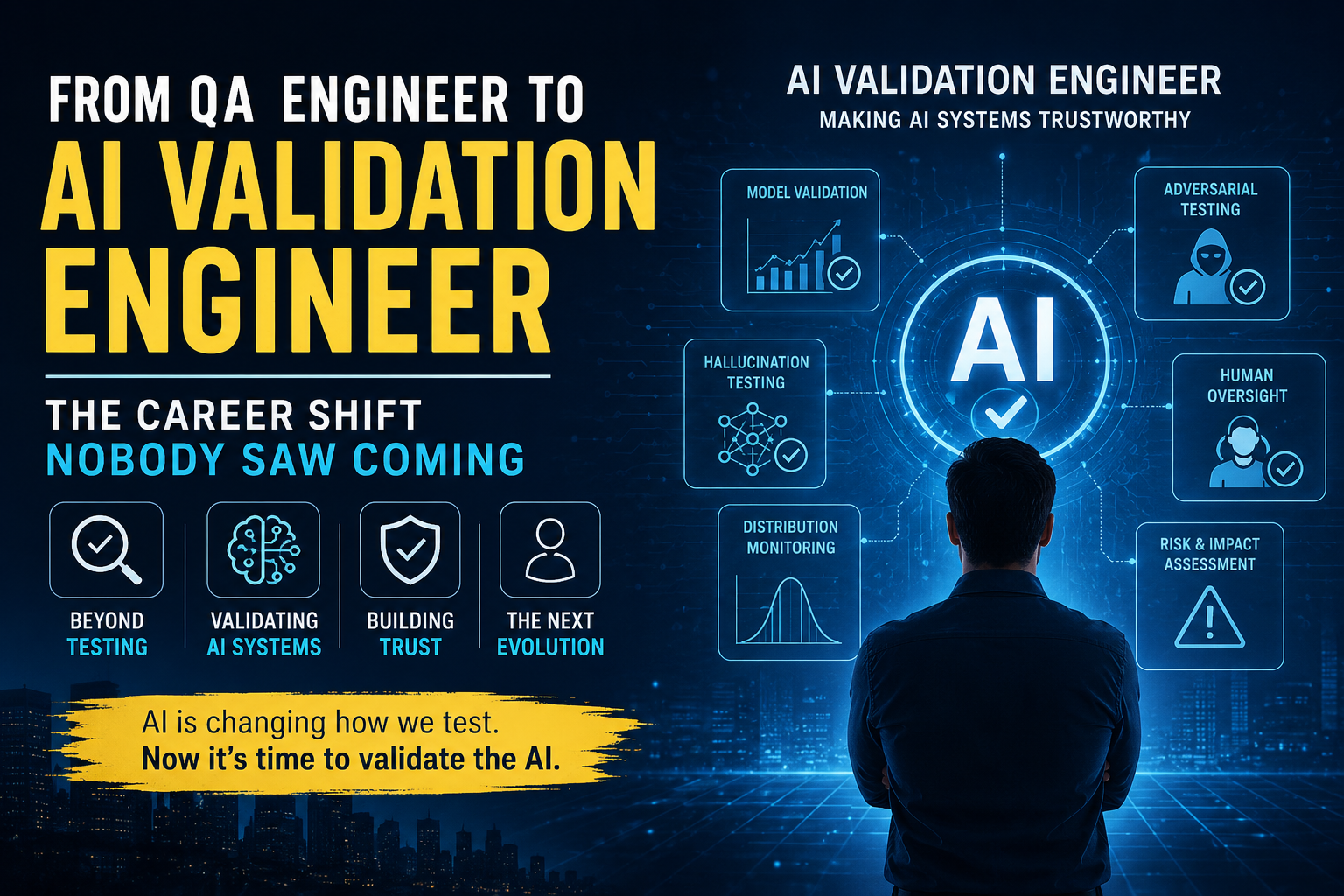
For the past nineteen years, I have dedicated myself to software quality engineering, testing a wide array of systems, from telecommunications to healthcare. The field has transformed significantly, evolving from traditional waterfall methodologies to agile, and from manual to automated testing, all while moving from on-premise to cloud-based environments.
However, a recent change has felt far more disruptive than any of these transitions. The emergence of artificial intelligence in testing has not only altered the way we test software but has also introduced a new, unprecedented challenge: how do we validate the AI systems that are now responsible for testing?
About a year ago, while reviewing test results from an AI-assisted testing tool, I noticed something peculiar. Despite the dashboard appearing clean and the model flagging anomalies effectively, I found that the model was consistently confident about a category of transactions that had remained stable for two years. The model had never encountered this new payment processing rule, which had only recently been added to the product.
It had only seen a limited set of data during its training, and thus, it was not equipped to recognize this subtle edge case. This realization prompted a deeper understanding of the unique challenges that AI validation poses to quality engineering.
Traditional quality assurance (QA) training prepares engineers to identify defects in deterministic software, where failures are obvious - an error is thrown, a test fails. However, AI systems operate differently. When they fail, nothing breaks. The model runs, producing outputs that may contain inaccuracies, hallucinations, or missed defect categories, all of which go unnoticed by traditional test cases.
This discrepancy in failure modes requires a new set of skills: understanding how probabilistic models fail, identifying distribution shifts, building adversarial test suites, and focusing on confidence calibration and consistency testing, all of which are not part of conventional QA education.
Recognizing this gap, I have begun contemplating a new role: the AI Validation Engineer. This role does not involve building AI testing tools or using them daily. Instead, it focuses on ensuring that AI systems perform as expected in the specific domain they are intended for. The responsibilities include defining what failure looks like for AI systems, establishing domain-specific validation infrastructure, building and maintaining adversarial test suites, and monitoring for distribution shifts in production.
Additionally, the AI Validation Engineer must oversee the human oversight layer, determining when and how human intervention is necessary, particularly for high-stakes decisions. This role is crucial yet currently unfilled in most organizations, highlighting a significant opportunity for quality engineers to develop new skills in machine learning and domain-specific AI validation.
Written by urgent.news from HackerNoon's reporting — not their text. Machine-written — may contain errors; check the original before relying on it.