BepiColombo Makes Up-Close Measurement of Mercury's Solar Bombardment
BepiColombo's measurements of particle bombardment at Mercury will help assess the impact of space storms on Mercury's surface and on Earth's atmosphere.
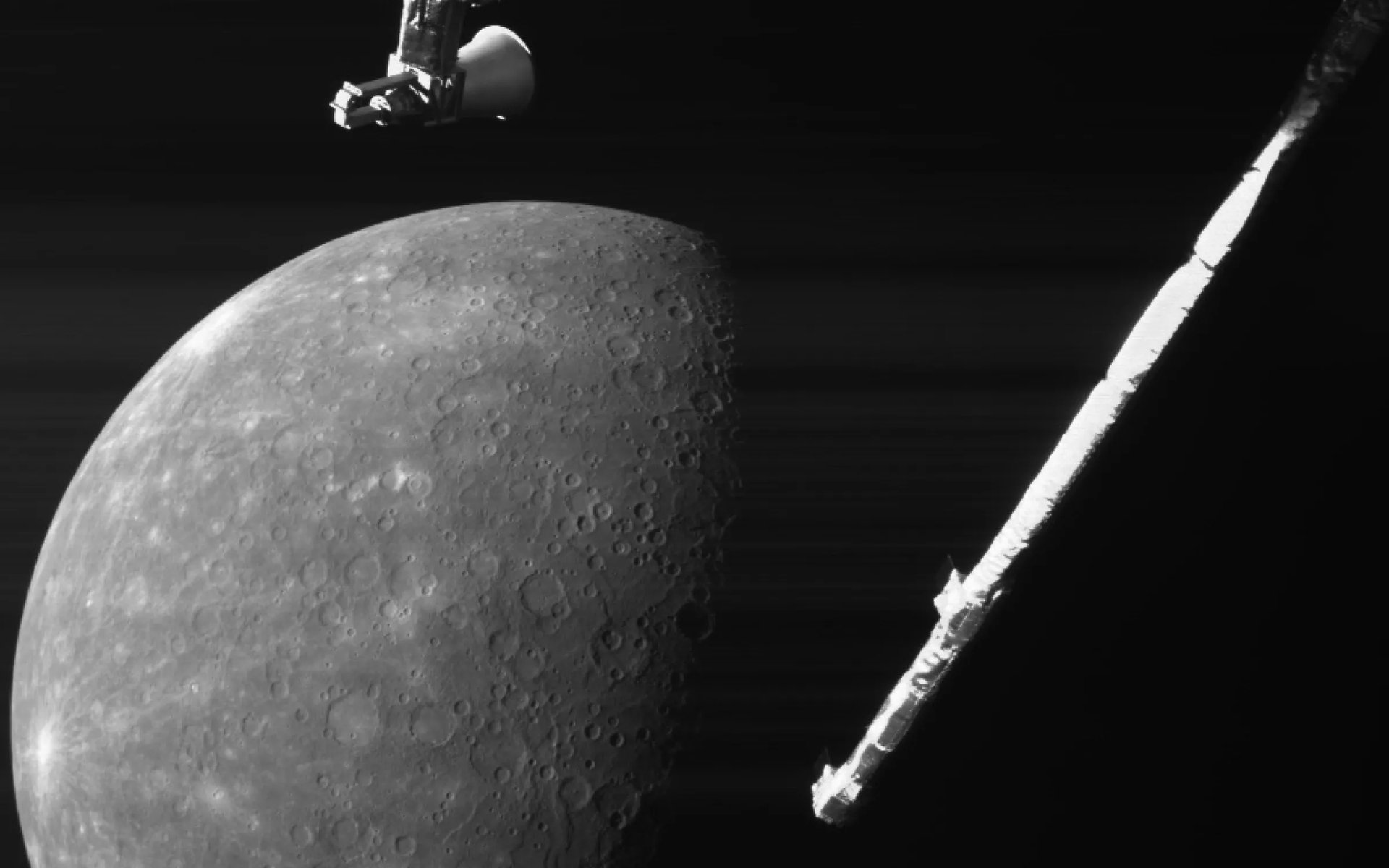
Between 2018 and 2025, the joint ESA/JAXA BepiColombo mission executed six close flybys of Mercury, gathering crucial data on this underexplored planet. These flybys shed light on Mercury's poles, magnetic field, and peculiar surface features like hollows. The Solar Intensity X-ray and Particles Spectrometer (SIXS) onboard the mission examined how solar particles and space storms affect Mercury.
During the fourth flyby in September 2024, SIXS captured the impact of solar particles penetrating Mercury's magnetic field on its surface. A University of Helsinki-led study published in Nature Astronomy revealed these findings could aid space weather predictions. Emilia Kilpua, the study's lead author and SIXS PI, described the mission's September 4th pass as the closest to Mercury's surface, even closer than its final orbit.
This proximity, combined with high-energy charged particles from a solar eruption, provided a rare opportunity to study how planets near their stars protect themselves. The interaction of these particles with Mercury's surface generated X-rays, as detected by SIXS. This unique flyby coincided with conditions similar to Earth's during a powerful solar storm compressing the planet's magnetosphere.
Kilpua and her co-author Rami Vainio emphasized that Mercury's magnetic field and smaller magnetosphere could help assess the potential damage of extreme solar events on Earth's near-space environment and infrastructure. The observations from SIXS will also inform the Center of Excellence in Space Resilience, focusing on safeguarding commercial and scientific operations in Low Earth Orbit (LEO) against the most severe space weather conditions.
Following the fourth flyby, the Mercury Planetary Orbiter (MPO) and Mercury Magnetospheric Orbiter (Mio) separated from the transfer module in November and will enter Mercury's orbit, with the orbiters splitting apart by December.
Written by urgent.news from Universe Today's reporting — not their text. Machine-written — may contain errors; check the original before relying on it.