North Korea’s nuclear tests awaken fault lines pointing to huge volcano at China border
North Korea’s underground nuclear tests have triggered a chain of seismic events, activating ancient fault lines that stretch towards one of the most dangerous volcanoes on Earth, about 100km (62 miles) away, according to a paper published by the journal Science. The joint Chinese and South Korean study, which appeared on Thursday, found that the five nuclear explosions conducted between 2013 and…
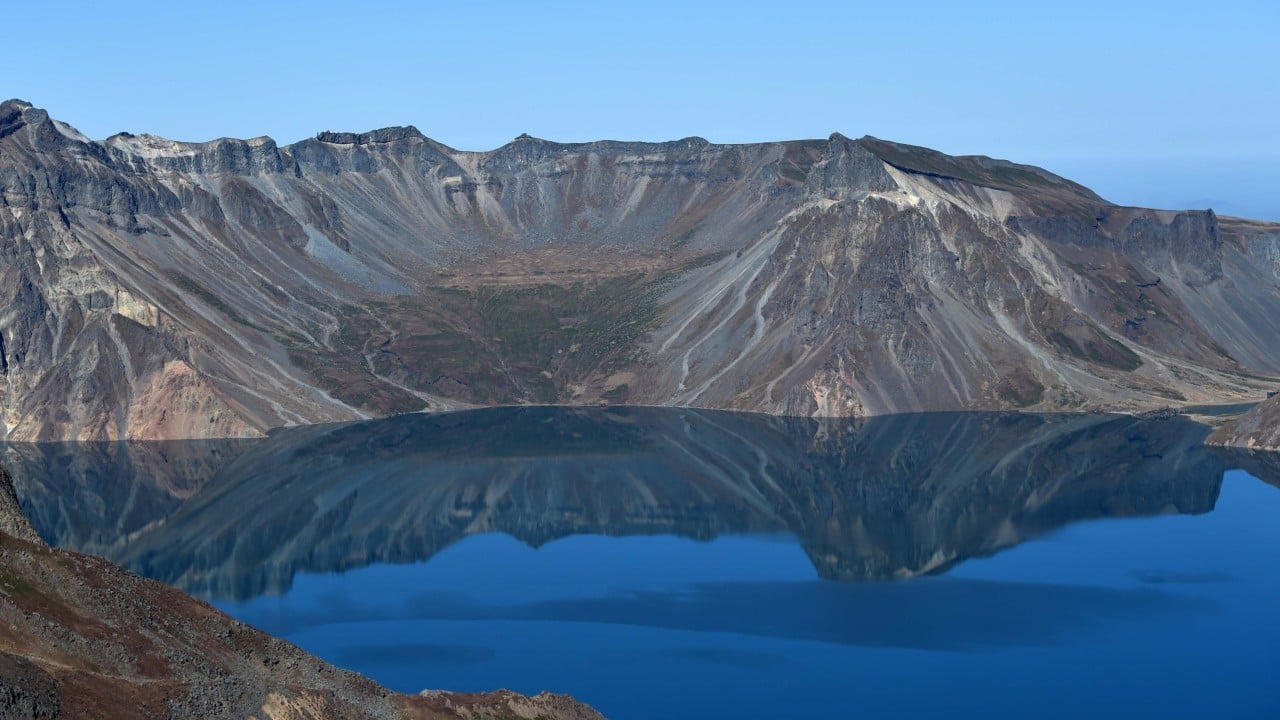
North Korea's nuclear tests have reportedly triggered a series of seismic events, activating dormant fault lines that extend towards a potentially volatile volcano near the China-North Korea border, according to a new study published in the journal Science. The research, conducted jointly by Chinese and South Korean scientists, reveals that the five underground nuclear explosions carried out between 2013 and 2017 at the Punggye-ri test site beneath Mount Mantap have significantly altered the region's geological stability.
These tests have not only persisted for nearly a decade but have also intensified steadily, propagating along two distinct parallel fault zones heading directly towards Changbai Mountain (also known as Mount Paektu), a dormant but restless volcano located at the northern border of China. Corresponding author Kwang-hee Kim from Pusan National University in South Korea stated that while the influence of the nuclear tests on Mount Paektu's volcanic system is physically conceivable, direct observational evidence confirming this connection has yet to be observed.
The study highlights that the seismic activity caused by the nuclear tests has significantly surpassed what is typically expected from such explosions, with the last and largest test in 2017 estimated to have a yield of 100-250 kilotonnes of TNT, which is considerably more powerful than the atomic bomb dropped on Hiroshima. Prior to the nuclear tests, the global seismic catalogue did not record any earthquakes within a 50km radius of the area.
However, seismic activity surged dramatically following the tests. In May 2018, North Korea announced plans to dismantle the Punggye-ri site, but seismic activity continued to rise until May 2025, when experimental data collection concluded. The researchers employed high-precision relocation of seismic sources and discovered that the seismic events following 2017 formed two nearly parallel structural zones extending north-northwest from the test site.
These structural belts exhibited coherent fault-scale structures, suggesting that the earthquakes were caused by the large-scale nuclear tests rather than being random occurrences. The study suggests that the nuclear tests modified the local stress field, progressively damaging the shallow crust and easing the delayed reactivation of pre-existing structural weaknesses, rather than merely inducing short-lived, localized responses.
Written by urgent.news from Reuters Business via SCMP's reporting — not their text. Machine-written — may contain errors; check the original before relying on it.