Could Chinese explorers have settled New Zealand before the Maori?
For generations, the narrative of New Zealand’s human settlement has held that Polynesian voyagers – the ancestors of the Maori – arrived and settled the islands in the 13th century, followed by European explorers in the 17th century. This timeline underpins New Zealand’s history and its political model. The Treaty of Waitangi, signed in 1840 between the British Crown and about 540 Maori chiefs,…
For decades, scholars have maintained that Polynesian explorers – the forebears of the Maori – were the first humans to inhabit New Zealand in the 13th century. This timeline forms the backbone of New Zealand's history and political framework, with the Treaty of Waitangi, signed in 1840, establishing the country's sovereignty under British rule. However, two independent researchers are challenging this established narrative by suggesting that Chinese explorers may have arrived in New Zealand centuries earlier.
Citing underwater shipwrecks, carbon-dated structures, and anomalous artifacts, scholar Sheng-Wei Wang has proposed a theory that a Chinese "treasure ship" fleet met its fate in New Zealand around 1435–1436 after colliding with a meteorite. Wang also argues that Chinese mining and trading activities in New Zealand date back to 190BC, contradicting the widely accepted 13th-century Maori settlement story.
While mainstream academics and Maori groups remain skeptical, Wang and others claim that acknowledging this lesser-known history could alter New Zealand's national identity and improve its relations with China. At the Commonwealth of World Chinatowns conference in Penang, Malaysia, Wang questioned whether fleet leader Zheng He, who led seven massive naval expeditions across the Indian Ocean, died in New Zealand during his final voyage.
Zheng is believed to have passed away in 1433 in Calicut, India, after setting sail in 1431, but Wang suggests he may have died during a visit to New Zealand in 1435 or 1436.
Wang's research is based on field surveys by the late British surveyor T.C. Bell, who detected 78 shipwrecks using magnetic anomaly surveys to locate metal objects. Twenty-four of these wrecks were of super-junk or treasure-ship size, with unique double-fluke anchors designed to secure ships in the sea floor. Wang proposed a route for Zheng's final voyage that took the fleet westward to New Zealand after it explored the Americas and rounded the southern part of South America.
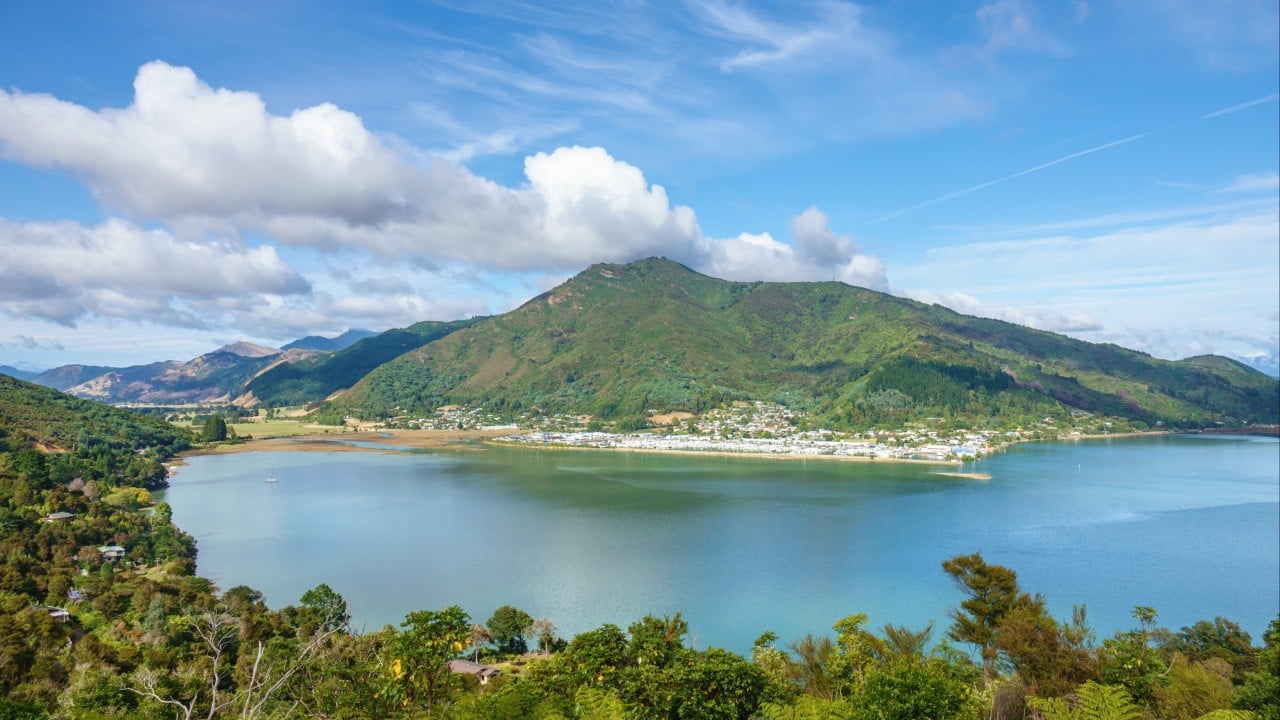
Carbon dating results indicate a Chinese presence in New Zealand dating back to 190BC, extending through 1600. Wang pointed to a "scrub-covered, small-moated Chinese fort platform" at Governors Bay on the South Island, carbon-dated to 190BC, as well as the years 800 and 1600. She proposed that New Zealand may have served as the headquarters of Chinese business trading ships and noted the presence of coal mining, metallic ores, canals, smelter sites, and barrack blocks with Chinese characteristics.
A massive gateway rock on the North Island also features an elephant petroglyph and linear script, which Wang claims is evidence of Chinese influence.
Critics, including Li Yuelin, the president of the Seven Seas Institute of Chinese Calligraphy in Illinois and a physicist at Argonne National Laboratory, question the authenticity of the elephant petroglyph, stating that the workmanship appears primitive and its origin remains uncertain. Li also noted that by the period Wang identified, from 200BC to 1000AD, the Chinese writing system had already evolved into a mature script, making the carved symbol unlikely to be Chinese.
Written by urgent.news from South China Morning Post's reporting — not their text. Machine-written — may contain errors; check the original before relying on it.