Ask Ethan: How did atoms come to be?
At the core of everything we’ve ever touched, seen, or interacted with here on Earth is the same humble physical structure: the atom. Each human body possesses around 10²⁸ of them, and they come in just under 100 different species, or elements, through natural processes, and we’ve synthesized several dozen more in laboratory experiments. Combined, atoms bind together to make unfathomably…
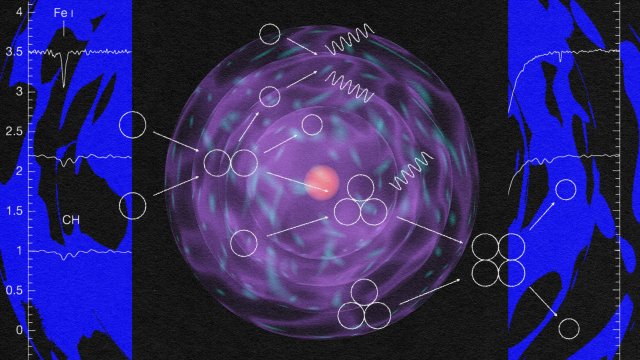
The universe's history ultimately led to the formation of atoms, which make up everything we know on Earth. These atoms consist of just over 100 elements and make up around 10^28 atoms in each human body. At the beginning of the hot Big Bang, there were no atoms or their core constituents, such as atomic nuclei, protons, or neutrons.
Electrons and their antimatter counterparts, positrons, were present along with all the fundamental particles and antiparticles of the Standard Model. The extreme conditions back then prevented any bound structures from forming. However, as the universe expanded and cooled, photons and other massless particles redshifted, losing energy.
Massive particles, including quarks, leptons, antiquarks, and antileptons, also lost energy as matter waves or particles traveling through expanding space. After a brief period of annihilation, there was a tiny excess of matter over antimatter. Eventually, when the universe cooled sufficiently, quarks bound together to form hadrons, eventually giving rise to protons and neutrons.
Electrons followed suit as they annihilated with positrons, leaving behind an excess of electrons—about one for every six excess quarks. This resulted in a neutral Universe. Protons and neutrons then interacted and interconverted through weak interactions, adjusting the proton/neutron balance and electron counts. Lastly, a fraction of the neutrons radioactively decayed, and by the time the Universe was over three minutes old, the background radiation cooled enough for Big Bang nucleosynthesis to occur, synthesizing the first atomic nuclei.
Written by urgent.news from Big Think's reporting — not their text. Machine-written — may contain errors; check the original before relying on it.