EU Chief Proposes Historic ‘Associate Member’ Status for Canada
In an unprecedented reshaping of transatlantic relations, European Commission President Ursula von der Leyen used her annual State of the EU address on Wednesday, Sept. 16, 2026, to propose that Canada become the 27-nation bloc’s first official “associate member.” Addressing the European Parliament in Strasbourg, with Canadian Prime Minister Mark Carney in attendance, von der […]
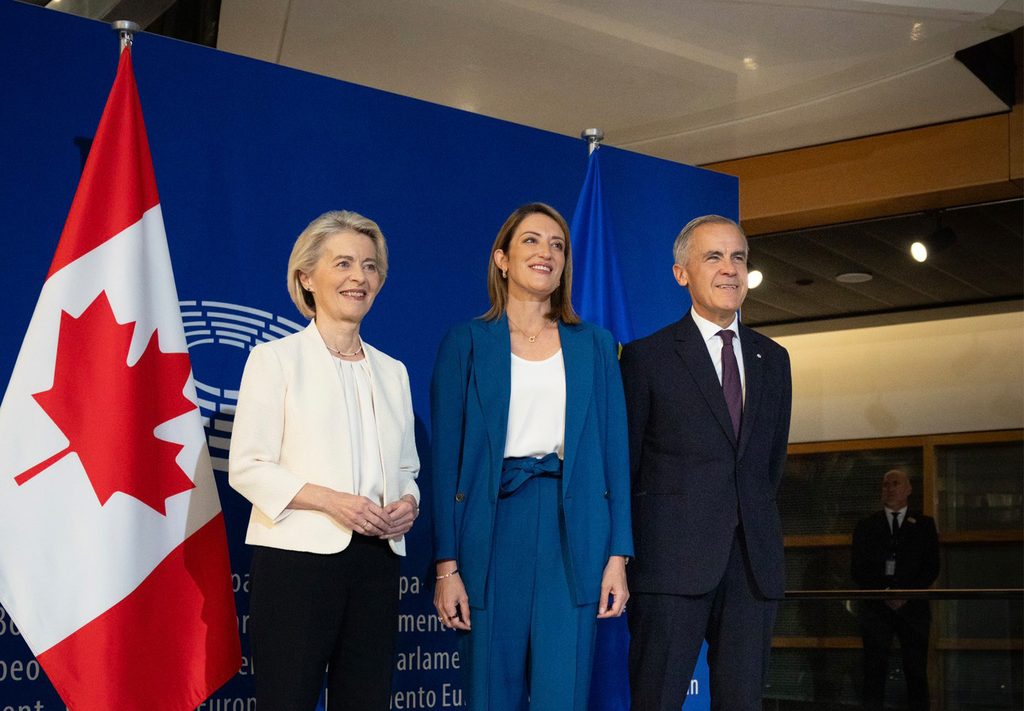
European Commission President Ursula von der Leyen unveiled a groundbreaking proposal during her annual State of the EU address on September 16, 2026, suggesting Canada become the European Union’s inaugural "associate member." The unprecedented suggestion took place in Strasbourg, where she addressed the European Parliament alongside Canadian Prime Minister Mark Carney, who was present in person.
Von der Leyen envisioned an "alliance for the future" to bolster transatlantic connections amidst a fractured international landscape. This proposal arrives as both Canada and the EU confront rising tensions with the United States, particularly under former President Donald Trump. Notably, U.S.-Canada trade talks recently failed, resulting in escalating trade disputes with tariffs and counter-tariffs.
Trump's rhetoric has further strained relations, with claims of Canada as the "51st state" and depictions of U.S. flags across North America and Greenland. Although von der Leyen’s announcement was met with a standing ovation, the legal framework for "associate membership" remains undefined. Article 49 of the EU Constitution restricts formal membership to European nations.
The concept of associate status was initially introduced by German Chancellor Friedrich Merz in relation to Ukraine. Under the EU's proposed framework, an associate member would partake in EU summits, hold a representative role within the European Commission, and have access to certain EU funds without full voting privileges. Implementing this proposal would present significant legal and economic hurdles, requiring unanimous approval from all 27 member states, a task complicated by the fact that 10 EU capitals have yet to ratify the Comprehensive Economic and Trade Agreement (CETA) with Canada.
While Canada aims to increase its non-U.S. trade by 2029, reducing its dependency on the United States remains a considerable challenge. Canada's annual bilateral trade with the U.S. exceeds $900 billion, whereas total trade with the EU amounts to around $130 billion. However, escalating tensions with the Trump administration have spurred Canada to explore alternative defense partnerships, including German submarines and Swedish early-warning aircraft, as well as participation in EU defense initiatives like the Security Action for Europe (SAFE) fund.
Mark Carney is set to deliver remarks at the European Parliament on Thursday before meeting with Britain's new Prime Minister, Andy Burnham, in Liverpool. The visit coincides with Britain's distinct approach to EU relations, as Labour Prime Minister Burnham faces domestic political challenges. Meanwhile, in Scotland, Wales, and Northern Ireland, leaders have united in a memorandum demanding self-determination and advocating for rejoining the EU, amid Trump's endorsement of a united Ireland.
Von der Leyen also proposed a formal European Security Council, including the UK and Ukraine, to enhance European security cooperation alongside NATO during her Strasbourg speech.
Written by urgent.news from Colombia One's reporting — not their text. Machine-written — may contain errors; check the original before relying on it.