BRICS 2026: From Representation to Economic Agency
BRICS 2026 signals a shift from representation to economic agency, deepening South-South trade, finance, technology and industrial ties.
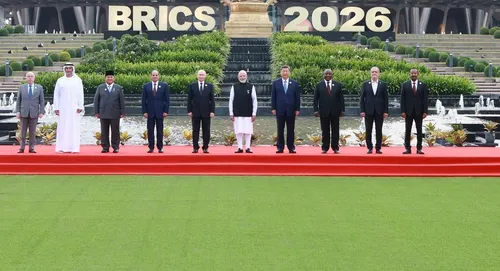
The 18th BRICS Summit held in New Delhi on September 12-13 marked a turning point as the world's major emerging economies realized they could no longer be passive players in a global economy dominated by others. The 11 BRICS nations signed the New Delhi Declaration outlining a comprehensive plan covering trade, investment, finance, technology, artificial intelligence, development, energy, food security and global institution reform.
This was more than a political statement; it demonstrated a practical push to create cooperative mechanisms between emerging powers.
For India, the current BRICS chair, the summit emphasized that developing countries must shift from merely following rules to shaping them. Prime Minister Narendra Modi framed this as transitioning from a "pyramid of privilege" to a "platform of partnership". While increased representation is crucial, the ultimate goal is to gain economic clout.
Financial cooperation proved to be one of the most practical areas of focus. Despite speculation, BRICS did not create a unified currency. Instead, members continued exploring ways to use local currencies more, improve cross-border payment systems and work towards interoperable digital payment infrastructure. The declaration also backs greater local-currency financing through the New Development Bank and work on a BRICS investment platform.
This approach aims to reduce dependence on a single financial system by making it easier for businesses in emerging markets to trade, invest and settle payments using their own currencies.
The summit also pushed industrial development and technology to the forefront. Chinese President Xi Jinping called for deeper economic cooperation and proposed initiatives covering AI, trade and industrial development. China introduced the idea of a BRICS AI Open Source Zone highlighting the growing significance of technology among developing economies.
This development could help shift BRICS economies away from merely exporting raw materials to higher-value production, leveraging their natural resources, growing consumer markets and young populations. For South Africa and the wider continent, BRICS collaboration is increasingly tied to boosting industrialization, infrastructure development and value addition through stronger trade, investment and intra-BRICS cooperation, especially in light of the African Continental Free Trade Area.
Politically, the summit emphasized the need for reforming global governance institutions like the UN Security Council and international financial architecture to give developing countries greater representation. Russian President Vladimir Putin called for stronger representation for Asia, Africa and Latin America, while Xi Jinping advocated for a more equitable global order.
This goes beyond just obtaining seats; it reflects a broader belief that economic power distribution has outpaced the structures governing the international system. The BRICS bloc now seeks to ensure their economic weight is reflected in global rules governing trade, finance, development and decision-making.
Finally, the New Delhi Declaration addressed major international conflicts, including the situation in West Asia and Palestine. BRICS members opposed the displacement of Palestinians and called for diplomacy, sovereignty and peaceful conflict resolution. This demonstrates that BRICS is becoming a platform where Global South countries can express their positions outside traditional Western-led groupings, despite having diverse foreign policies and strategic interests.
The summit highlighted that despite differing policies, BRICS countries can still find common ground, particularly in areas like development, sovereignty, trade, investment and a more representative international system. The New Delhi Summit signifies another significant step in BRICS' evolution from an emerging economies platform to a bloc with growing economic agency.
Written by urgent.news from IOL's reporting — not their text. Machine-written — may contain errors; check the original before relying on it.