US F-1 Visa New Rules 2026: What Changes From September 15 For International Students, OPT & Programme Transfers; Harvard, Columbia, Yale Issue Guidance
US F-1 Visa New Rules 2026: A major change in how international students are admitted and maintain their status in the United States will take effect from September 15, 2026, when the US Department of Homeland Security (DHS) replaces the long-standing “duration of status” system with a fixed period of admission for F-1 students. DHS published the final rule, titled “Establishing a Fixed Time…
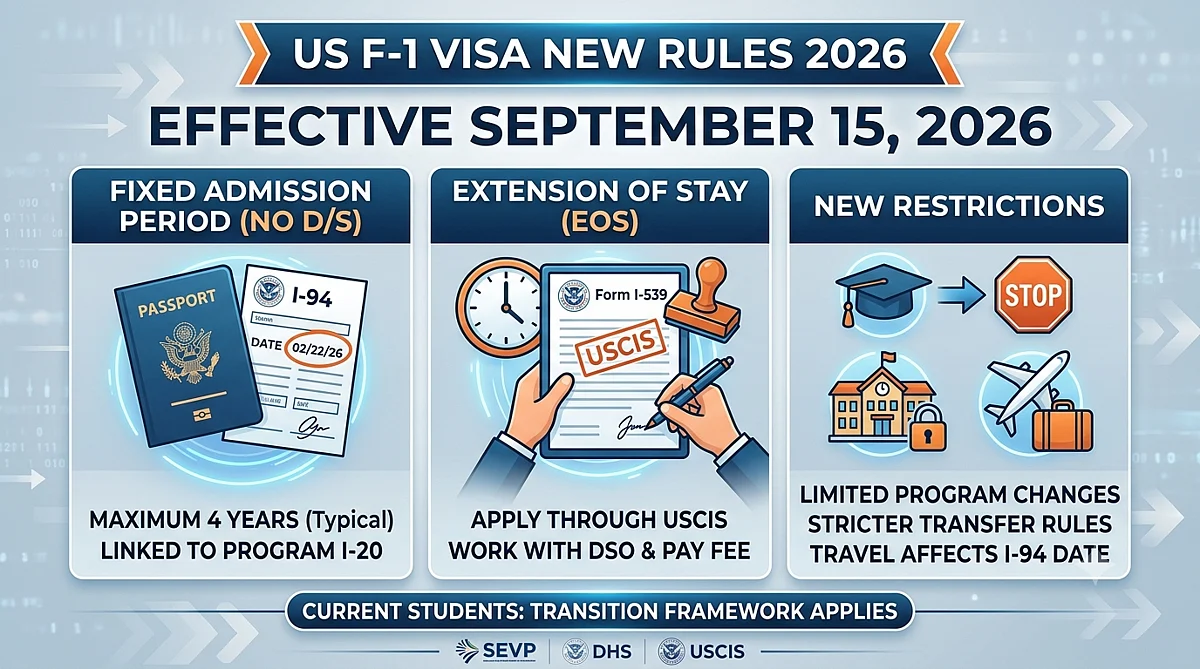
Effective September 15, 2026, the US Department of Homeland Security (DHS) will replace the longstanding "duration of status" system with a fixed period of admission for F-1 students, impacting international students, Optional Practical Training (OPT), and program transfers. The new rule, titled "Establishing a Fixed Time Period of Admission and an Extension of Stay Procedure for Nonimmigrant Academic Students, Exchange Visitors, and Representatives of Foreign Information Media," will limit F-1 students' admission periods to the length of their academic program, subject to a maximum of four years.
Students will receive a 30-day grace period before their program start date to enter the US and a similar grace period after completing their program or eligible post-completion training to prepare for departure or seek another lawful status. English-language training programmes have a 24-month limit, while public high school students are limited to 12 months of aggregate time.
One of the most significant changes is the introduction of an Extension of Stay (EOS) process for students needing to remain in the US beyond their authorized admission period. Students may apply to the US Citizenship and Immigration Services (USCIS) for an extension, working with their Designated School Official (DSO) beforehand. Students with unexpired visas who travel outside the US may seek a new admission period upon return, subject to eligibility and admissibility requirements.
Changes also affect students wishing to change their educational level, major, or institution. Students below the graduate level generally cannot change educational levels or majors during their first year unless an exception is authorized. Graduate students face stricter restrictions, with changes generally prohibited unless an applicable exception is authorized. Students who have completed a program will also face restrictions on enrolling in another program at the same or a lower educational level.
Transfers between institutions are also impacted, with students below the graduate level generally unable to transfer during their first year. Graduate students may not transfer during their program, subject to exceptions for extenuating circumstances.
Written by urgent.news from Free Press Journal's reporting — not their text. Machine-written — may contain errors; check the original before relying on it.