Parlamentswahl: Schwedens Wahlkrimi: Reicht der Abba-Hit als Glücksbringer?
Die Wahl ist vorbei, das Drama geht weiter: Zwar haben die Sozialdemokraten in Schweden die meisten Stimmen geholt. Ob es in dem skandinavischen Land zum Regierungswechsel kommt, ist aber offen.
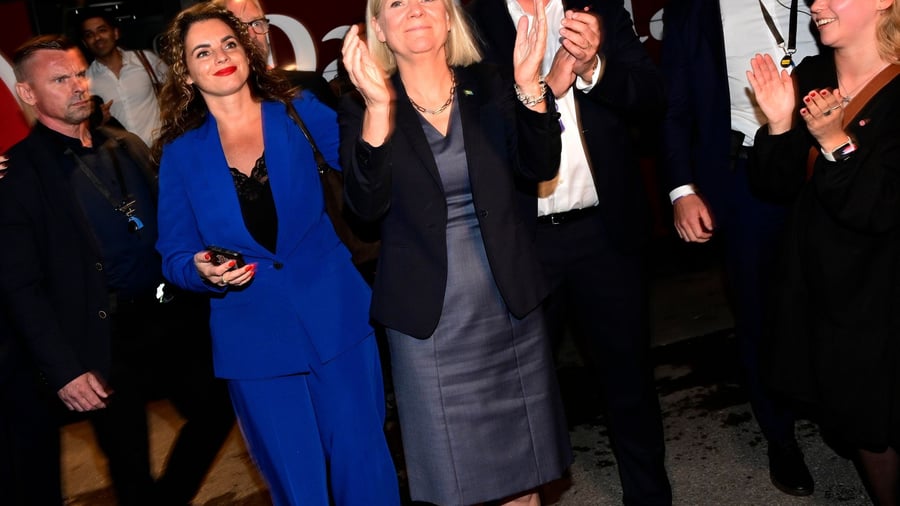
The Swedish parliamentary election isn't over yet. The Social Democrats are expected to be the strongest force, and their center-left coalition could secure a narrow majority in the parliament. However, their leading candidate, Magdalena Andersson, faces obstacles in forming a coalition. Not all votes have been counted yet, so Ulf Kristersson, the conservative prime minister, has not given up on possibly remaining in power.
This could allow far-right populists to join a coalition for the first time. Who is the election winner remains uncertain. So far, 94 percent of the votes have been counted. The Social Democrats gathered 28.1 percent of the votes, with Andersson receiving support from Swedish music royalty Benny Andersson, who reworked the chorus of "Mamma Mia" to "Magdalena" during a campaign event.
The Social Democrats stated that the prominent backing may have ignited a decline in their vote count compared to 2022 (30.3 percent), putting them at three seats below the conservative government's coalition. The Social Democrats, along with three other center-left parties supporting Andersson, currently have a thin majority of 176 out of 349 seats, compared to 173 for the government party and far-right populists.
The outcome is not final. Moreover, within Andersson's camp, there is no unanimous harmony. Kristersson's conservative government managed to slightly increase their vote count (19.9 percent) compared to 2022 (19.1 percent). The Christian Democrats (6.2 percent) and Liberals (5.4 percent), who previously governed with Kristersson, also performed better than in the last election.
However, the Swedish Democrats saw a bitter defeat, falling to 17.6 percent and possibly facing their worst performance ever in a parliamentary election (2022: 20.5 percent). The far-right populists have performed poorly, primarily due to their focus on fighting gangs and harsher penalties for criminal foreigners. Their own success may have backfired, as fewer shootings and terrorism may have made them less appealing, according to political journalist Ivar Arpi from Kvartal.
Economic issues were crucial for Swedish voters, with disappointment over cuts in unemployment benefits and rising medication costs outweighing the Rechtspopulisten's efforts. As the night of the election drew to a close, the waiting game began. Only on Wednesday will the final votes be counted, including those from Swedish citizens abroad and late submissions before the election.
Andersson still has much to worry about in forming a coalition, as the Center Party refuses to cooperate with the Linker party. The alternative for Magdalena Andersson is a centrist government, but neither the Christian Democrats nor the Liberals are interested. Kristersson's government is also in a precarious position, needing a minority coalition, but not a majority against them.
Only the Center Party can potentially block a majority, which they have no intention of supporting. The Swedish Democrats are keen on their first government participation, which Kristersson also supported before the election. The final election results are expected over the weekend, with little hope for a quick victory in forming a government. The clear indication is that a new election may be on the horizon.
Written by urgent.news from Handelsblatt's reporting — not their text. Machine-written — may contain errors; check the original before relying on it.