North Korea tests weapons capable of striking South Korea: ‘huge destructive power’
North Korea said on Monday it conducted a joint live-fire drill involving missiles, artillery and drones that it claimed showed “huge destructive power”. The official Korean Central News Agency (KCNA) said Saturday’s drill was meant to get familiar with the procedure for the operation of the integrated firepower control system. South Korea’s military earlier said it detected short-range ballistic…
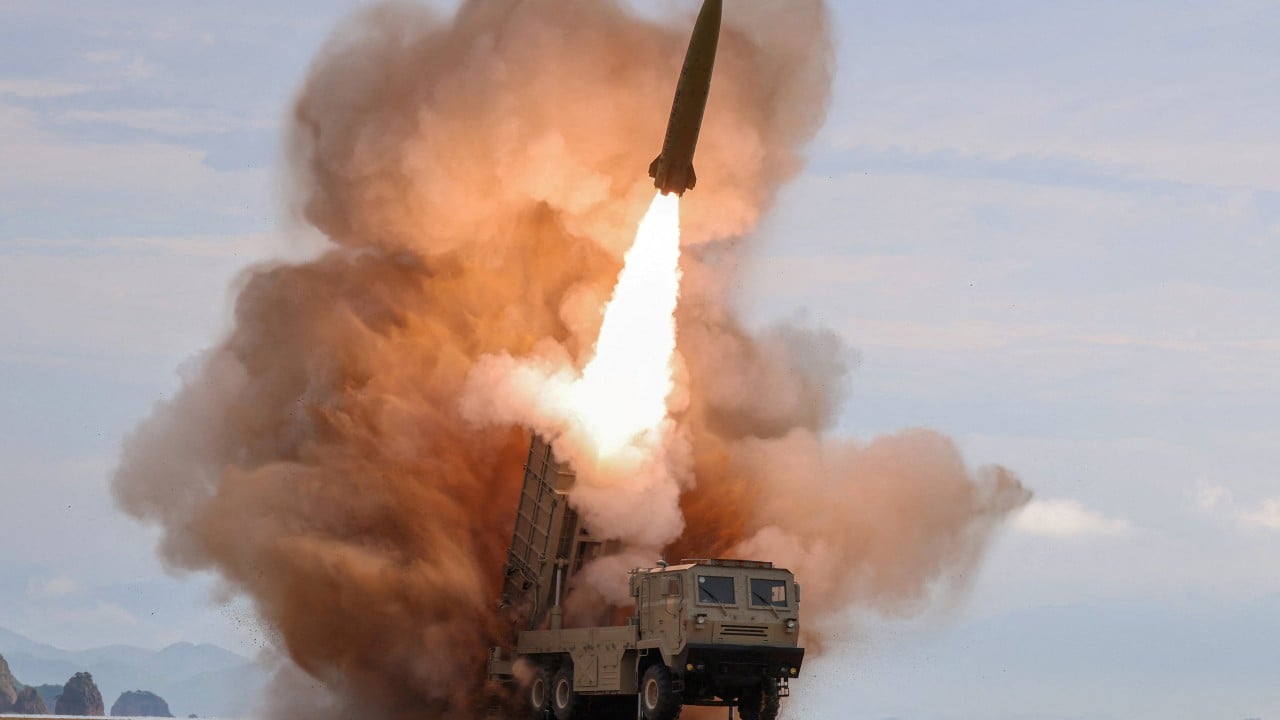
On Monday, North Korea carried out a joint live-fire drill involving missiles, artillery, and drones, claiming to demonstrate "huge destructive power". This drill, as reported by the official Korean Central News Agency (KCNA), aimed to familiarize personnel with the procedure for operating an integrated firepower control system.
South Korea's military detected short-range ballistic missile launches from North Korea's eastern coastal Wonsan area earlier that morning. After reviewing the drill, Marshal Pak Jong-chon stated that the exercise would enhance the expertise required to neutralize the enemy's armed forces organizationally and structurally. He also noted that the weapon systems employed showcased the "huge destructive power of concentrated fire," according to KCNA.
The drill involved five army units and tested various weapon systems, including attack drones, tactical cruise missiles, tactical ballistic missiles, and large-calibre multiple rocket launchers, as per KCNA. Despite the challenge of independently verifying North Korean claims on weapons tests, South Korea's Joint Chiefs of Staff reported that each missile fired on Saturday traveled approximately 250km (155 miles) towards North Korea's eastern waters, indicating their design to strike targets in South Korea.
This was North Korea's first public ballistic missile launch in roughly three weeks, according to Lim Eul-chul, a professor at Kyungnam University's Institute for Far Eastern Studies in Seoul. Lim described the drill as a demonstration of an integrated strike network, emphasizing the coordination of drones, cruise missiles, ballistic missiles, and rocket artillery through a unified command-and-control system.
The absence of North Korean leader Kim Jong-un and the delayed report suggested Pyongyang intended to present the event as a technical and practical military exercise while gauging tensions. Kim Jong-un's decision to scale back a major bilateral military drill with South Korea last month, citing a good relationship with Kim, was an apparent attempt to revive diplomacy between the two nations.
However, North Korea rejected Trump's overture, stating that shortening the drill did not alter its "provocative, aggressive nature". With his expanding nuclear arsenal and strengthened ties with Russia and China, experts believe Kim may believe he holds more leverage in potential diplomacy with the US than when he first met Trump in 2018-2019.
Kim had previously stated that he would return to talks if the US abandoned its "hostile policy" against his country and acknowledged the North's status as a nuclear state.
Written by urgent.news from South China Morning Post's reporting — not their text. Machine-written — may contain errors; check the original before relying on it.
This story
This is one outlet's version. Read the fullest account.
- N. Korea reports latest missile launches, calling it strike drill koreatimes.co.kr
- North Korea says missile launches were part of live-fire drills brecorder.com
- North Korea says it conducted ‘firepower attack drill’ freemalaysiatoday.com
- (LEAD) N. Korea reports latest missile launches, calling it strike drill en.yna.co.kr
- North Korea says its recent live-fire drill demonstrated ‘huge destructive power’ winnipegfreepress.com
- North Korea says its recent live-fire drill demonstrated 'huge destructive power' gulfnews.com
- North Korea says it conducted 'firepower attack drill' channelnewsasia.com