Kommunalwahl: Höhere Wahlbeteiligung zeichnet sich in Niedersachsen ab
Unter dem Eindruck der VW-Krise und des Ausschlusses mehrerer AfD-Kandidaten entscheiden sechs Millionen Niedersachsen über ihre Politik vor Ort. Warum die Wahl gleich mehrfach als Stimmungstest gilt.
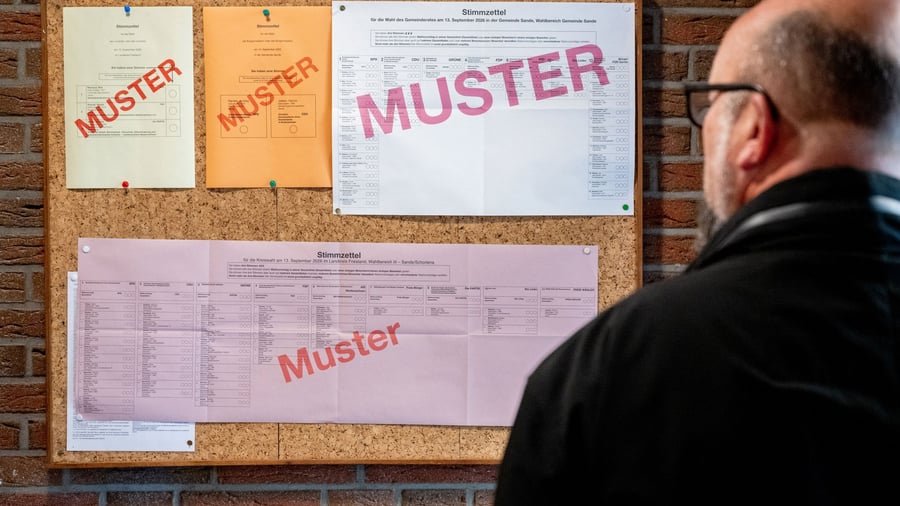
Many people in Niedersachsen participated in the local elections, casting their votes for communal representatives in counties, cities and communities, as well as for mayors, city mayors and district governors. Over 6.3 million people were called upon to elect more than 29,000 seats and more than 68,000 candidates. By noon, a slightly higher turnout was noted.
The state election office reported that 24.60 percent of eligible voters took part in the local elections at 12:00. This was 3.31 percentage points higher than the turnout in the local elections five years ago, when it stood at 21.29 percent. Four AfD candidates are barred from taking part in the elections. The local elections are not only a sentiment test in the Rot-Grün-regulated Niedersachsen before the next state parliament election.
They are also a barometer of how the AfD is currently doing in a federal area. In the 2021 local elections in Niedersachsen, the AfD achieved 4.6 percent at the county level. Unlike then, the AfD Landesverband is now observed as a right-wing extremist object by the Verfassungsschutz. The party is fighting the legal assessment. However, four AfD candidates were not allowed to participate due to doubts about their constitutional fitness.
For example, AfD Landesvize Stephan Bothe will not be able to run as Lüneburg Landrat. The first results from the direct elections for mayors and others are expected around 7:00 PM. The first results from the counties are expected around 10:30 PM. The provisional national county results are expected to be released Monday morning - the same as in the 2021 elections.
The local elections are also the first nationwide elections since Olaf Lies took over as Minister-President from Stephan Weil (both SPD) a year ago. Lies cast his vote in his hometown of Sand in Friesland. "I hope that voters look closely at the candidates on site," he said to the Deutsche Presse-Agentur after voting. "It's not a small Bundestag election, but a genuine personality election.
And it's all about the own community, city or county." However, federal politics is also closely watching the vote in Niedersachsen. The voting in the Wadden Sea, Heide and Harz is seen as an important sentiment test before the elections in Mecklenburg-Vorpommern and Berlin on Sunday. Above all, the CDU is watching closely to see if Chancellor Friedrich Merz can calm down after a feared debacle in Mecklenburg-Vorpommern, where the CDU is currently at 7 percent in the polls, after the Fiasko in Saxony-Anhalt.
How strong is the SPD still in its former stronghold of Hannover? The SPD is of immense importance for the coalition government in the Land. Especially in the state capital, the election could have a signal effect for the Social Democrats. In 2019, the SPD was defeated by the Green politician Belit Onay - after more than 70 years of SPD rule in Hannover.
Onay is again leading the polls for the OB election this year. If the SPD fails to win a possible runoff and also performs poorly elsewhere in Niedersachsen, it could fuel debates within the party about the low-ranking vice chancellor and co-Bundesparteichef Lars Klingbeil. Possible runoff elections take place on September 27th.
Hannover is especially under the spotlight for another reason: as one of the locations where Volkswagen may shut down a factory in the coming years. The same applies to Emden. In Wolfsburg, the AfD already came as close to the SPD as the SPD itself in the 2025 Bundestag election, even though both lag behind the CDU. The success of the AfD in Saxony-Anhalt could give the party further wind beneath its wings.
In the 2021 local elections, the CDU came out on top with 31.7 percent, followed by the SPD with 30.0 percent. The Greens achieved 15.9 percent, the FDP 6.5 percent, the AfD 4.6 percent and the Left 2.8 percent. The turnout was 57.0 percent back then. For the upcoming state parliament election in Niedersachsen, Minister-President Lies and CDU Land Chancellor Sebastian Lechner will face each other.
In an Insa opinion poll published on Friday on behalf of Bild for the political mood on a state level in Niedersachsen, the SPD came out ahead of the CDU with 26 percent. The CDU trailed with 22 percent. However, the AfD has also declared its own government ambitions. The Insa opinion poll saw the party trailing behind the CDU with 21 percent.
Opinion polls are always subject to uncertainties, especially due to waning party affiliations and increasingly short-term election decisions, making it difficult for polling institutes to weight the collected data. Insa gives a maximum statistical error tolerance of 3.1 percentage points. Generally, opinion polls only reflect the opinion picture at the time of the survey and are not forecasts for the election outcome.
Written by urgent.news from Handelsblatt's reporting — not their text. Machine-written — may contain errors; check the original before relying on it.