New Research Says that Early Galaxies Could be Sending us Neutrinos
Those "Little Red Dots" discovered by the James Webb Space Telescope, galaxies that existed during the very early Universe, could be sending neutrino particles that are reaching us today.
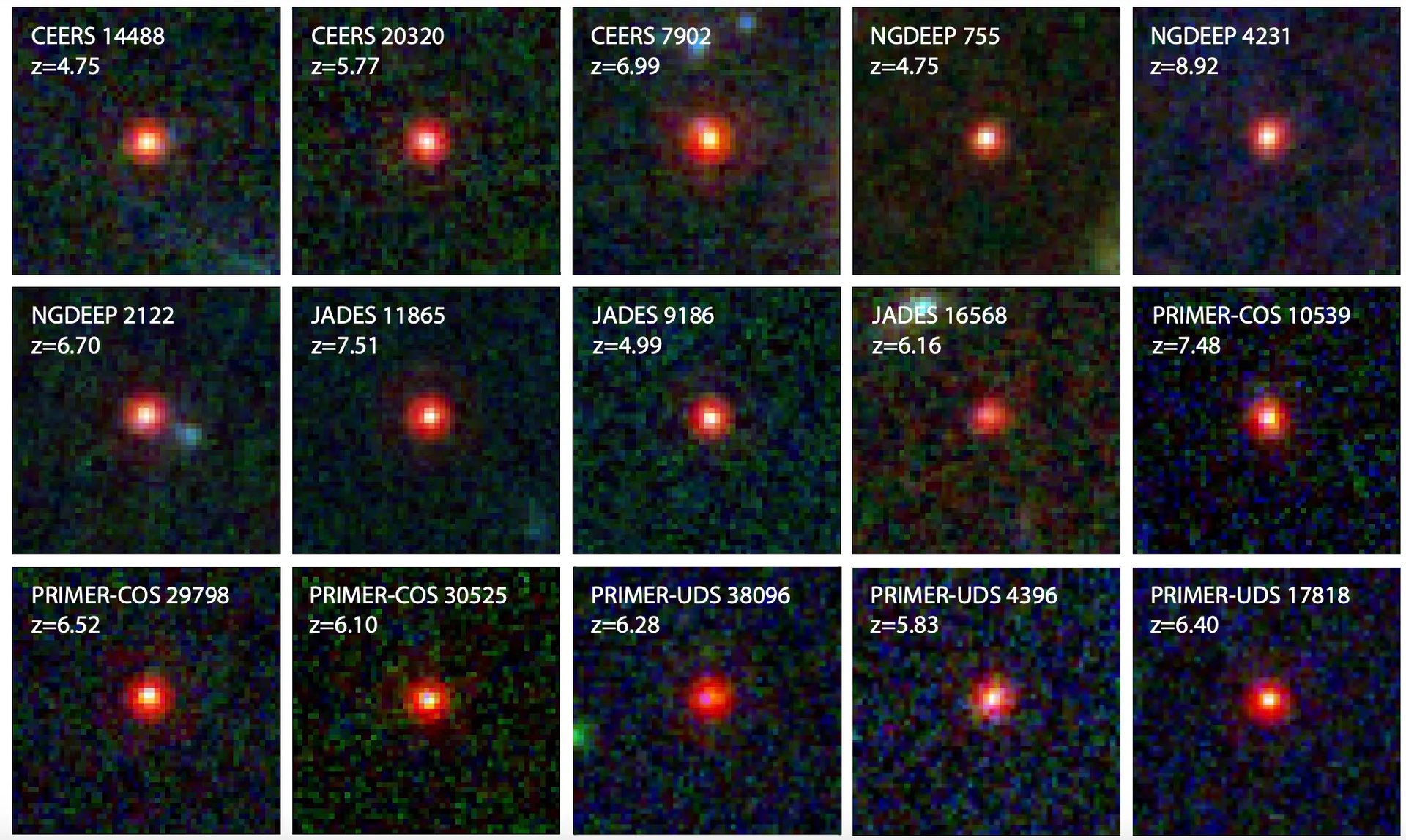
Shortly after the James Webb Space Telescope (JWST) became operational, it began observing the early Universe. Astronomers discovered numerous small red objects, dubbed Little Red Dots, that were high-redshift galaxies from around 0.6 to 1.6 billion years after the Big Bang. These galaxies likely contained growing supermassive black holes (SMBHs) at their centers, making them early quasars.
Scientists theorize that these SMBHs are hidden within gaseous envelopes from which they formed directly after massive gas clouds collapsed to create massive black holes. A new study led by Riku Kuze suggests that this environment could produce high-energy neutrinos. These neutrinos, if detected today, would have traveled over 13 billion years to reach us.
The research team, including colleagues from Penn State, Tohoku University, and Kavli Institute for Astronomy and Astrophysics, used data on the Little Red Dots' luminosity and number density to estimate their potential contribution to the all-sky neutrino background. Their calculations indicate that if high-energy particle acceleration occurs in concealed environments, Little Red Dots could emit high-energy neutrinos while suppressing gamma rays.
Written by urgent.news from Universe Today's reporting — not their text. Machine-written — may contain errors; check the original before relying on it.