2027 Android Phones Could Boost Gaming Graphics and AI Tasks With Arm’s New Chip Tech
Advancements in AI-based upscaling and frame rate upgrade mobile gaming performance and power efficiency.

Arm, a leading semiconductor design company, unveiled its latest CSS for Mobile 2 technology, a significant advancement in smartphone chip technology that promises to revolutionize gaming graphics and AI tasks in Android phones released next year. The primary focus of this innovation lies in the GPU, which has been meticulously redesigned to empower AI to enhance graphics and elevate frame rates, delivering an unparalleled mobile gaming experience on premium Android devices.
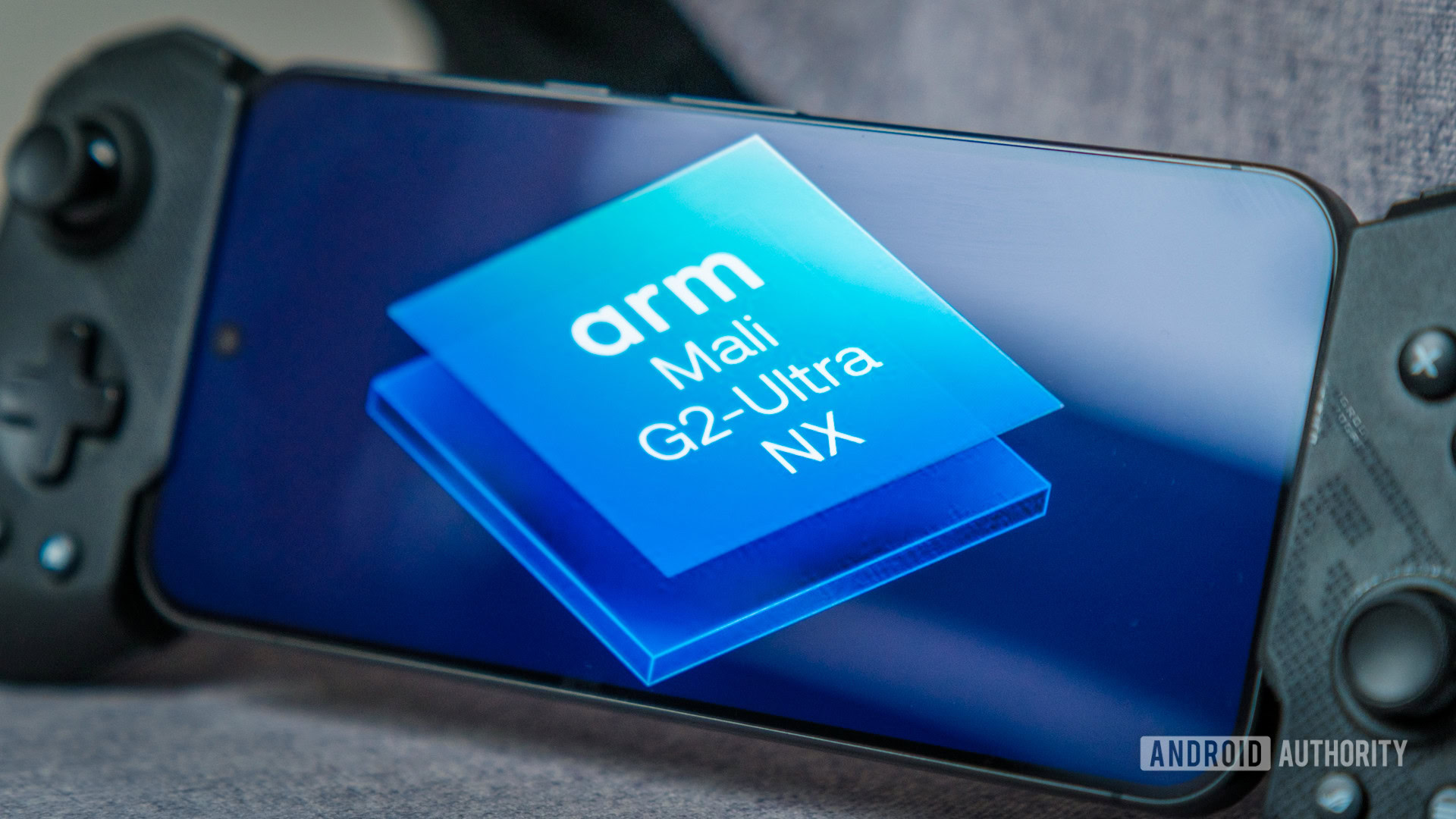
The new GPU, dubbed Mali G2-Ultra NX, is Arm's first AI-native GPU, capable of performing AI acceleration directly within the graphics pipeline. This integration eliminates the need for data transfer between AI-driven sections, such as the neural processing unit, resulting in reduced latency and improved power efficiency. Arm's Mali G2-Ultra leverages three cutting-edge AI methods to upscale graphics: neural super sampling, neural frame rate upscaling, and neural super sampling and denoising.
These techniques can elevate resolution from 540p to 1080p, generate additional frames between rendered sequences, and eliminate visual "noise" in complex graphical scenes like ray-traced reflections and intricate lighting.
By rendering graphics in lower resolutions and fewer frames, smartphones can achieve a smaller form factor while potentially reducing costs. Chris Bergey, executive vice president of Arm's Edge AI Business unit, highlighted the benefits of this approach, stating that delivering an impressive 540p, 30 frames per second experience can enable the use of smaller batteries and more affordable handheld devices.
During a pre-announcement brief, Arm showcased a game co-developed with Sumo Digital to demonstrate the AI methods' potential. The game, set in a fantastical cave system illuminated by glowing mushrooms, exemplified how developers can utilize these AI features to deliver 4x higher performance efficiency and up to 70% lower external memory traffic compared to traditional graphics rendering. These improvements led to a 24% boost in benchmark performance and a 14% enhancement in ray tracing capabilities.
In addition to the GPU advancements, Arm introduced next-generation C2 CPU cores tailored for AI agent workflows on devices. The C2 cores boast up to 15% higher single-thread and 12% higher multi-thread performance, along with a 1.7x improvement in AI model processing, while consuming 38% less power. They also facilitate faster app launches and web browsing.
With their superior single-thread performance, these cores reduce latency, while their multi-thread performance enables concurrent task execution. Arm's C2-ultra cores completed a sample agentic workflow combining various tasks, including speech processing, memory retrieval, reasoning, application execution, and web browsing, 24% faster than their predecessors.
The integration of these cutting-edge chip technologies into smartphones will likely be determined by individual chipmakers, who must balance performance, efficiency, and cost when designing their system-on-chip configurations. Last year's MediaTek Dimensity 9500, featuring an eight-core CPU with a mix of C1-Ultra, C1-Premium, and C1-Pro cores, exemplifies this strategic decision-making process.
Written by urgent.news from CNET's reporting — not their text. Machine-written — may contain errors; check the original before relying on it.