Prabowo-Putin payoff: can bond between Indonesian, Russian leaders translate to gains?
The rapport between Indonesian President Prabowo Subianto and his Russian counterpart, Vladimir Putin, was evident when the two met during the 11th Eastern Economic Forum (EEF) in Vladivostok last week. “My profound apologies for missing this important event due to urgent matters I needed to attend to back home but I’m now here to repay my debt,” Prabowo told Putin on Wednesday, referring to a…
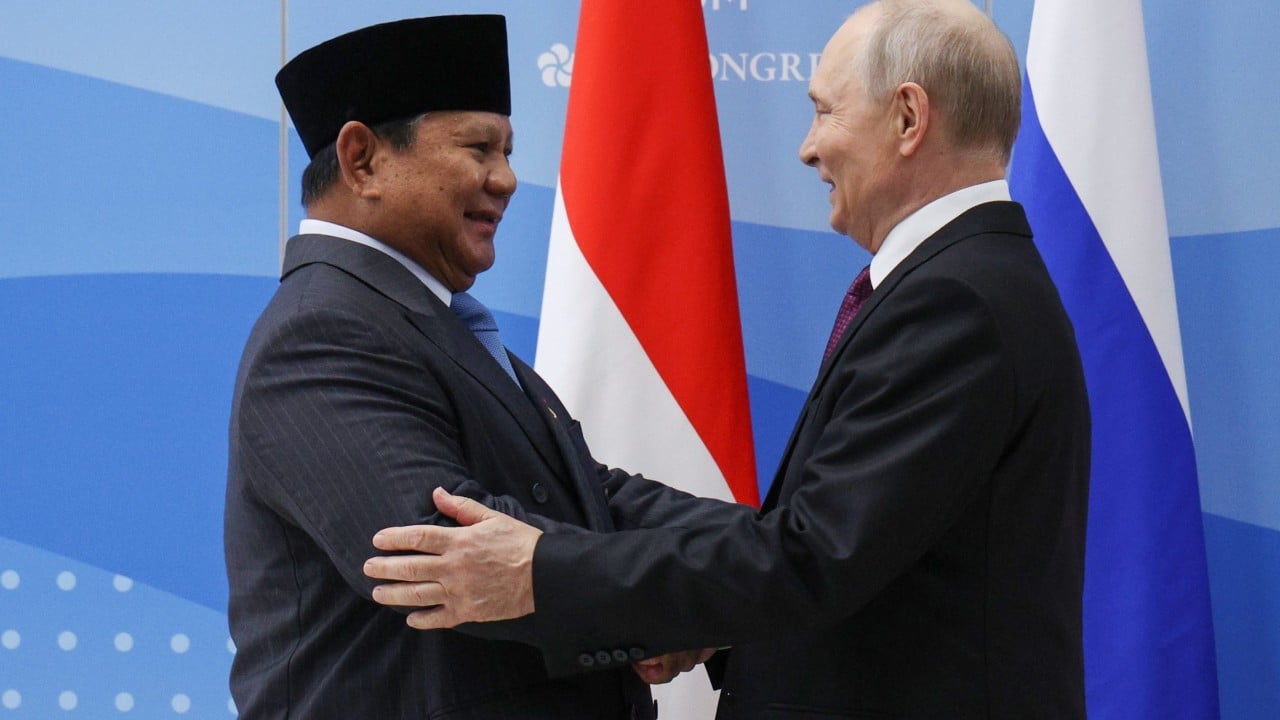
Indonesian President Prabowo Subianto and Russian President Vladimir Putin seemed to have a strong bond during their meeting at the 11th Eastern Economic Forum (EEF) in Vladivostok. Prabowo expressed his apologies for missing the event previously, stating that he is now there to repay his debt. Putin acknowledged their "personal contact" and "strategic nature of the relationship between Russia and Indonesia".
The EEF aims to encourage investment and development in Russia's Far East, with delegations from around 50 countries, including China and Myanmar, in attendance.
While Prabowo's visit could boost Indonesia's international profile, analysts are uncertain if the camaraderie between the two leaders will lead to tangible results. Bawono Kumoro, a researcher at Jakarta-based pollster Indikator Politik, believes that Prabowo's efforts to work with various international partners showcase his ability to navigate geopolitical challenges.
Dipo Satria Ramli, an economist at the Centre of Reform on Economics, sees potential in the trade relationship between Indonesia and Russia, which currently stands at US$5 billion, or 1% of Jakarta's total foreign trade. In 2022, Indonesia signed a free-trade agreement with the Eurasian Economic Union, which includes Russia.
Indonesia's non-alignment policy, however, presents challenges for strengthening the relationship. Prabowo's friendship with Putin may test the limits of Indonesia's neutrality, but according to Bawono, it doesn't violate the policy as long as Indonesia doesn't commit to any military alliance. Meanwhile, Radityo Dharmaputra, a foreign policy analyst and lecturer, doubts the strategic value of attending events like the EEF, suggesting that the relationship is more about Russia's interest than Indonesia's.
He also points out the lack of significant progress in the oil refinery project between Indonesia and Russia, as well as the limited scope of the Orruda joint naval exercise compared to the Super Garuda Shield. Overall, while the Prabowo-Putin relationship may hold promise for Indonesia-Russia cooperation, implementation remains a significant challenge.
Written by urgent.news from South China Morning Post's reporting — not their text. Machine-written — may contain errors; check the original before relying on it.