Institutional Finance Needs a Context Layer for AI Workflows
In institutional finance, AI failures often come from missing context, not bad models. Here’s why validation layers matter.
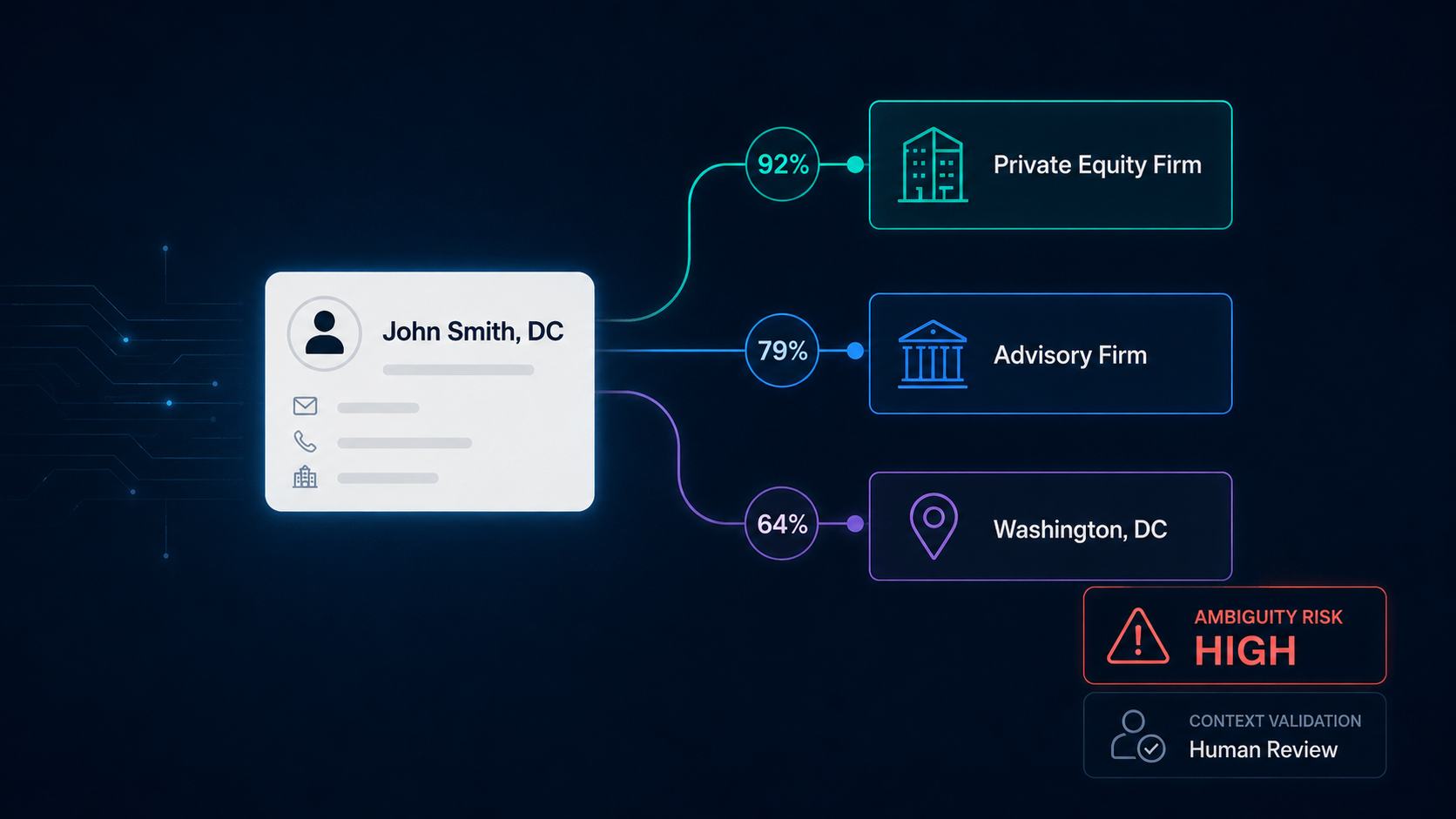
Institutional finance faces significant risks when implementing AI workflows due to a missing context layer that provides meaning to data. This can result in regulatory exposure, relationship damage, and financial loss. The industry's current focus on automation overlooks the need for a robust context layer that ensures data accuracy and reliability.
Errors in AI systems often stem from ambiguity in data, such as the term "DC" in an entry labeled "John Smith, DC." Without context, the system cannot determine if "DC" refers to a private equity firm, a bank, a geographic location, or unrelated information. This ambiguity quickly leads to incorrect data merging, reports, and sharing of confidential information.
Institutional finance data is fragmented and context-dependent, making it challenging for AI models to provide consistent results. Large entity models like Blackstone Group can be reliably resolved due to strong external training signals, but mid-market or regional players with limited public footprint may lead to failures in matching and decision-making.
Large language models are powerful but have limitations in institutional finance. They struggle to understand context and can produce convincing but incorrect answers. Moreover, confidential data constraints limit the ability to process information externally, which further complicates AI adoption.
Compliance risks are high in institutional finance, as errors can escalate into regulatory issues. The lack of explainability in AI decisions hinders accountability, as systems cannot provide clear logic paths when decisions are made. A validation layer between the model's output and decision-making is crucial to address these challenges.
The solution lies in implementing a context layer that separates the model's proposal from decision-making. This involves using deterministic rules, lookup tables, or human review for final decisions. Confidence should be made explicit, with low-confidence matches automatically routed to human reviewers instead of being processed by the system as is. Lastly, resolving manual cases feeds back into the system to improve future decision-making.
Written by urgent.news from HackerNoon's reporting — not their text. Machine-written — may contain errors; check the original before relying on it.