Germany's far-right AfD clear frontrunner in eastern state vote
German voters headed to the polls on Sunday for a key regional election in the ex-communist east where the far-right, anti-immigrant, Moscow- and Trump-friendly AfD is expected to secure an easy majority. Our correspondent Nick Holdsworth tells us more.
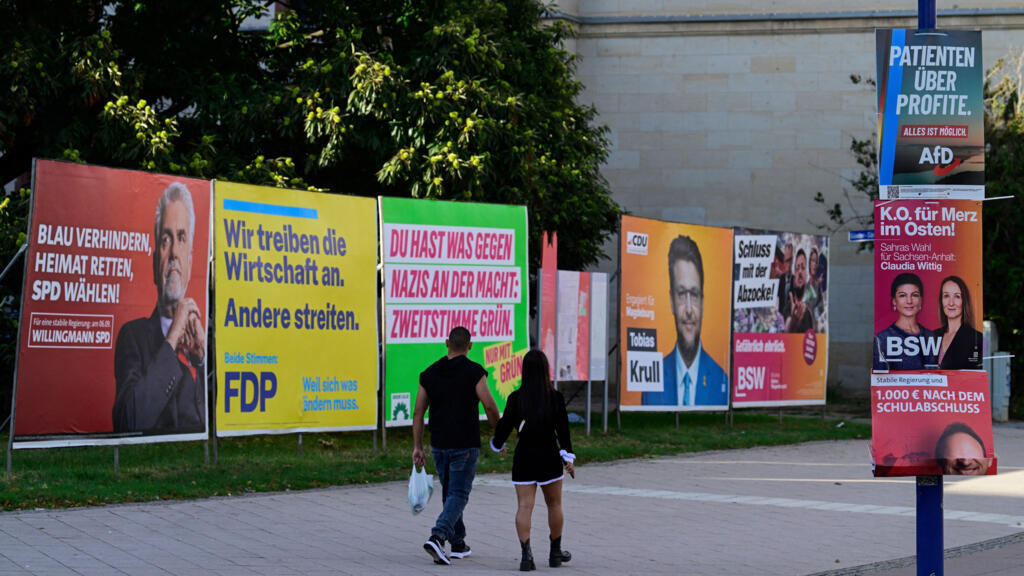
Voters in the eastern German state of Saxony-Anhalt are casting ballots in a pivotal election that could mark a historic moment - the first time a far-right party assumes power at a state level since World War II. Leading the Alternative for Germany (AfD) is 35-year-old Ulrich Siegmund, whose party has been polling ahead for months.
An absolute majority could be within reach, especially if smaller parties struggle to clear Germany's 5% threshold for entry into parliament. The vote is seen as a gauge for Chancellor Friedrich Merz's government, which has attempted to curb the AfD's popularity by adopting a tougher stance on migration and security. About 1.7 million eligible voters remain until the 6pm voting deadline (5pm Irish time) to submit their choices.
Preliminary results are anticipated shortly afterward. Recent polls suggest the AfD trails with just over 40% support, followed by the Christian Democrats (CDU) at 23%. An absolute majority would permit the AfD to bypass traditional party efforts to keep them out of power through a longstanding "firewall" policy. Without an outright majority, the CDU-led administration headed by incumbent premier Sven Schulze is the most probable outcome.
However, the specific coalition makeup hinges on the parties that enter the fray. Coalition negotiations could ensue following the election. The AfD sees the Saxony-Anhalt vote as a springboard for securing national power in the upcoming federal election in 2029. Should they prevail, the AfD plans to steer schools and cultural institutions towards more traditional values, marginalize immigrants, and radically reform the public broadcasting system.
However, without a decisive majority, the AfD, labeled as "far-right extremist" by the state security service, would likely be unable to form a government due to the firewall. Siegmund, who voted in his hometown of Tangermuende on a blue Simson moped amid a crowd of supporters, has ruled out joining any coalition with other parties, arguing that they are incapable of governing effectively alongside mainstream politicians who have neglected Germany over the past three decades.
He aims to secure 45% or more of the vote. If the AfD falls short of this target, complex coalition negotiations would unfold, contingent on which parties clear the 5% hurdle. Recent surveys show one of the CDU's coalition partners, the Free Democratic Party, is unlikely to reach the threshold, while the Social Democratic Party (SPD) trails under 10%.
The small far-left Sahra Wagenknecht Alliance (BSW), the sole party open to a potential AfD coalition, is also improbable to meet the mark. For Schulze, a frontrunner in polls as voters' top choice, a coalition with the SPD and Greens may not suffice for a majority. However, the CDU has dismissed a coalition with the far-left Left Party, which might assist in achieving the necessary threshold.
A minority government led by Schulze, reliant on passive endorsement from the Left, could be an alternative, akin to the model employed in neighboring Thuringia.
Written by urgent.news from RTE News's reporting — not their text. Machine-written — may contain errors; check the original before relying on it.
This story
This is one outlet's version. Read the fullest account.
- Germany's far-right AfD expected to win crucial eastern state vote lemonde.fr
- Germany's far-right AfD seeking victory in state election rte.ie
- Germany's far-right, pro-Russia party on brink of winning majority in key regional election kyivindependent.com
- AfD nears first far-right victory in Germany since World War II as Saxony-Anhalt votes jpost.com
- Germany's far-right AfD clear frontrunner in eastern state vote france24.com
- Germany's far-right AfD clear frontrunner in eastern state vote thelocal.de
- Germany braces for far-right breakthrough as AfD eyes first state government malaymail.com
- Exit polls: Germany’s far-right AfD holds clear lead in Saxony-Anhalt election politico.eu