Commentary: China’s real robot revolution is not about humanoids
The country is using its superpower of scaling and building supply chains to challenge the global industry, says Zijing Wu for the Financial Times.
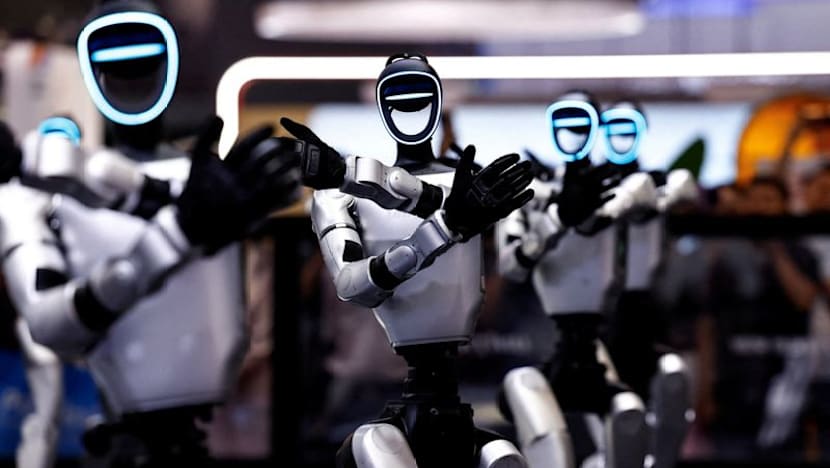
China is harnessing its immense manufacturing capabilities and supply chains to disrupt the global robotics landscape, according to Zijing Wu of the Financial Times. During a recent robotics conference in Beijing, the focus on humanoid robots seemed more like a spectacle than a serious demonstration of progress. The impressive display of robots stumbling and struggling to complete basic tasks drew global attention, fueling speculation about China's robot revolution.
This buzz led to Unitree, a company known for its humanoid robots, going public last month with a valuation exceeding 1,200 times its previous earnings. However, the real robot revolution in China has been quietly progressing in industry, focusing on practical and repetitive tasks rather than elaborate demonstrations. Instead of setting speed records or executing complex maneuvers, Chinese industrial robots handle mundane, repetitive tasks with remarkable efficiency.
In 2024, Chinese companies installed 295,000 new industrial robots, accounting for 54 percent of the global total. Two years ago, China was operating over 2 million industrial robots, more than four and a half times the number owned by Japan, the second-ranked nation. The Chinese robotics industry generated revenues exceeding $44 billion last year, with a five-year average annual growth rate exceeding 20 percent, based on data from the Ministry of Industry and Information Technology.
Chinese exports of industrial robots increased by 49 percent in 2025, marking the first year the country became a net exporter of these machines. Chinese manufacturers have now become the primary players in the domestic industrial robot market, previously dominated by global giants such as Fanuc, ABB, Yaskawa, and KUKA before 2024.
The proliferation of autonomous mobile robots in Chinese warehouses, precision surgical arms in hospitals, and specialized cleaning robots in skyscrapers is a testament to the practical applications of robotics in China. These devices are designed for specific purposes and lack human-like features. The application of these robots is evident in various sectors, including BYD's automated EV assembly line in Xi'an, Shanghai Yangshan Port's automated terminal, and the approval of 48 "Robot+" deployment scenarios in Guangdong province spanning manufacturing, logistics, and service sectors.
While humanoid robots continue to capture public attention, the majority of industrial tasks are best suited for specialized machines that do not resemble humans. The obsession with the human form in robot design may be driven by emotional resonance rather than efficiency. Although humanoid robots have the potential to bridge the gap between hardware and AI, enabling real-time reasoning and learning from vast video data of human activity, their current development is still far from being reliable enough for factory-floor applications.
Retrofitting existing environments for humanoid robots is costly and time-consuming, making them less practical for most industrial tasks. The flexibility of humanoid robots may appear to offer a solution, but in reality, it is a problem waiting to be solved more simply with optimized machines. Despite the potential of humanoid robots, the impact of specialized and non-humanoid robots on the future of robotics is undeniable.
China is already reshaping industries with its advanced robotic technologies, and their influence will only grow in the near future.
Written by urgent.news from Channel News Asia's reporting — not their text. Machine-written — may contain errors; check the original before relying on it.