Syria, eyeing role as Middle East hub, offers options to bypass Hormuz
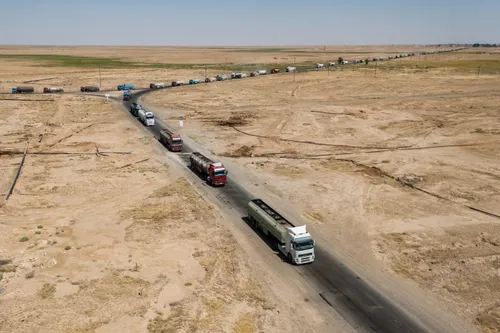
Day and night, 5,000 hulking trucks carrying oil from the Persian Gulf rumble across this stretch of barren desert as if in a caravan snaking its way toward the Mediterranean Sea.
Iran unleashed a series of retaliatory attacks against U.S. targets throughout the Middle East following a U.S. strike that killed four people during a wedding celebration in Sirik. The U.S. Central Command attributed the attacks to the Islamic Revolutionary Guard Corps (IRGC) in response to recent attempted attacks on commercial shipping in the Strait of Hormuz. This resurgence of hostilities signaled the end of a short period of calm that had followed previous summer exchanges.
According to Iran's Revolutionary Guards, two oil tankers were disabled after striking naval mines while attempting to pass through the Strait of Hormuz. The Iranian Red Crescent reported that the U.S. missile strike in Sirik resulted in four casualties, including a child, and over fifty injuries. Iranian state media claimed that additional projectiles struck Chabahar, Konarak, an airport in Jiroft, Qeshm Island, and Bandar Abbas.
In response to these attacks, the U.S. Navy Captain Tim Hawkins, representing Centcom, confirmed receiving reports from Iranian state media about the Sirik incident, emphasizing that the U.S. military never targets civilians. Simultaneously, Iranian forces launched a barrage of ballistic missiles targeting a U.S. Marine base in Aqaba, Jordan, where the Jordanian Armed Forces intercepted and destroyed ten missiles while three landed harmlessly in remote areas.
Jordan and Kuwait deployed air defenses, and Bahrain intercepted and destroyed incoming strikes following a threat alert.
President Donald Trump commented on the conflict, stating that he was not attempting to force Iran to the bargaining table and that Tehran's economy was collapsing due to pressure. He added that the U.S. controlled almost all aspects of the strategic shipping lane and questioned when the Iranian population might rise up. The Financial Times reported that Russia had secretly assisted Iran in developing advanced supersonic cruise missiles capable of threatening U.S. aircraft carriers and naval warships.
Ahead of the retaliatory strikes, Trump warned that Iran would face a "much harder and higher level" of retaliation if provoked. This escalation followed the expiration of a temporary June Memorandum of Understanding that extended a bilateral ceasefire, leading both nations to resume maritime confrontations by enforcing naval blockades and restricting vessel movements through the Strait of Hormuz.
The U.S. further tightened its containment strategy on August 24 by launching a new sanctions campaign against Iranian allies. Treasury Secretary Scott Bessent announced that many U.S. allies would implement additional penalties against Iran, while Bessent also claimed that the Strait of Hormuz would become useless within two years as oil trade transitions to land pipelines.
Iranian authorities dismissed these measures as unsuccessful economic tactics. However, Iranian President Masoud Pezeshkian proposed a diplomatic solution, stating that Iran would reciprocate if the U.S. returned to its commitments under the agreement.
Written by urgent.news from GBC Ghana's reporting — not their text. Machine-written — may contain errors; check the original before relying on it.
This story
This is one outlet's version. Read the fullest account.