SuperCDMS SNOLAB Starts Its Dark Matter Hunt
The search for dark matter has reached another milestone - in this case the start of science for one of the world’s newest detectors. The Super Cryogenic Dark Matter Search (SuperCDMS) SNOLAB just began its scientific operations in Ontario, and over the course of the next few years, hope to find direct evidence of “light” dark matter for the first time.
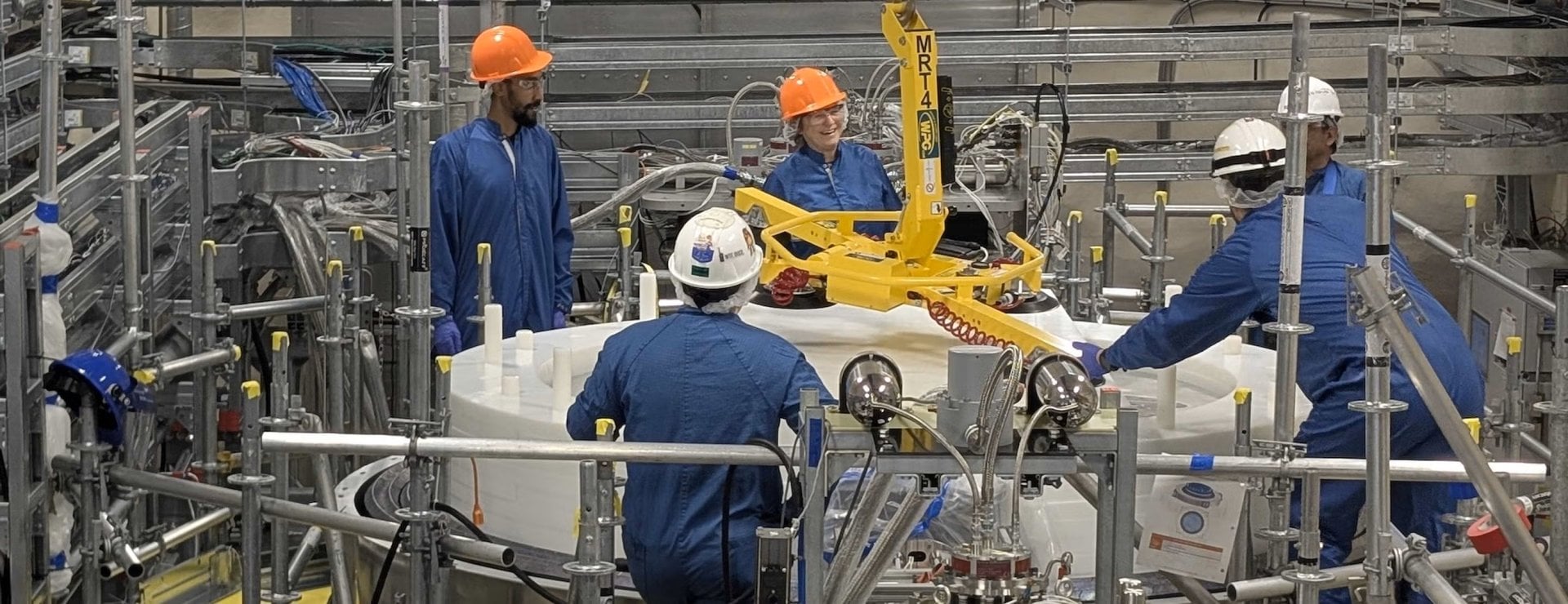
The Super Cryogenic Dark Matter Search (SuperCDMS) SNOLAB has commenced its scientific operations in Ontario, marking a significant milestone in the search for dark matter. Over the next few years, scientists hope to gather direct evidence of "light" dark matter for the first time. The project, which has been under construction since 2018, has now reached the "early-science" phase, where detectors are officially turned on to collect data.
Located deep inside the Vale Creighton mine, 1.6km underground near Sudbury, Ontario, SuperCDMS aims to detect "light" dark matter particles that barely interact with regular matter. These particles are so small that they leave behind only faint traces if they do interact.
The detector consists of 24 ultra-purified silicon and germanium crystals, each the size of a hockey puck. These crystals are cooled to temperatures near absolute zero, while the lab itself is shielded from other potential sources of interference. To detect dark matter, the crystals are fitted with superconducting sensors that pick up tiny vibrations and faint electrical signals.
Scientists, including Dr. Nicholas Hunt-Smith from the University of Adelaide, are exploring various theories on the source of dark matter, such as dark photons. The shielding system, which includes ultra-pure lead sourced from Roman shipwrecks, is designed to protect the sensitive detector from other forms of radioactivity.
The facility will undergo early experiments until the fall of this year, followed by a maintenance period. Full optimized science operations are expected to begin in 2027. The project has involved a collaborative team from 28 institutions and a nearly decade-long build cycle. If successful, SuperCDMS could provide crucial insights into the hidden universe or help narrow down the possible nature of dark matter.
Written by urgent.news from Universe Today's reporting — not their text. Machine-written — may contain errors; check the original before relying on it.