Will self-flying planes transform the skies?
Autonomous crop-spraying aircraft are leading the way in pilot-free flying.
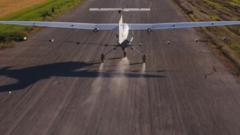
In an alfalfa field situated in the San Joaquin Valley of California, a pilotless crop-spraying plane hovers perilously close to the ground. The aircraft, designed and manufactured by Pyka, a start-up located in a converted World War II hangar overlooking San Francisco Bay, boasts an 11.5-meter wingspan. The flight engineer, Russ Marotzke, explains that flying lower reduces spray drift, thereby minimizing the need for chemical usage compared to traditional manned crop-dusting.
Pyka is among a handful of companies striving to bring autonomous fixed-wing aircraft into commercial service.
Autonomous fixed-wing aircraft have garnered less attention compared to urban air taxis, also known as electric vertical take-off and landing (eVTOL) aircraft. However, a quieter race is underway to deploy self-flying planes for tasks like crop spraying and cargo delivery, with many companies anticipating the possibility of passenger-carrying flights in the future.
Michael Norcia, co-founder and CEO of Pyka, aspires to have a fleet of minibus-capacity Pyka planes ferrying passengers along the US east and west coasts before the eVTOL industry reaches that milestone.
Marotzke and a colleague are testing a software update on one of Pyka's demonstration aircraft at a crop-spraying test site, approximately 50 miles east of the company's factory. The site, accessible via a bumpy dirt road, is one of several where Pyka's aircraft are deployed in Brazil to spray crops such as cotton and soybeans, replacing human pilots. The electric crop-spraying plane can fly for around 35 minutes and carries up to 300 liters of spray in a tank located in its middle.
The engineers demonstrate the spraying area using a computer, taking into account obstacles such as nearby power lines. The autonomous flight involves seamless take-offs from a runway beside the field and lands itself after sensing low spray levels for manual refill and battery swap. The aircraft then resumes its mission.
Autonomous flight differs from autopilot, which provides assistance similar to cruise control and lane-keeping functions in a car. Autonomous systems aim to handle the entire flight, including take-off and landing, with minimal human intervention, using algorithms to process sensor data and control the aircraft. Despite operating in a more structured and predictable environment, self-flying planes have been slower to emerge than self-driving cars.
This is partly due to the fact that big tech companies have focused on cars, pouring vast sums into the technology, and because aircraft face stricter safety standards, setting a higher bar for deployment.
Military interest has played a role in propelling the technology, with many companies receiving defence contracts to demonstrate and trial their systems. The US has approved Pyka's crop sprayer for commercial civilian use, although operations are restricted to a defined agricultural setting and require a ground operator and visual observer. Pyka aims to scale up production from around 24 planes per year to 1,000 by 2030, with each plane selling for $550,000.
The UK has not yet approved autonomous fixed-wing aircraft for longer-term operations, although British firm Windracers is seeking permission to launch an autonomous cargo service in Shetland and Orkney. Its cargo aircraft, designed for remote areas, is already flying missions in Ukraine. Supporters argue that autonomous aircraft could address pilot shortages, remove people from dangerous work, improve efficiency, and cut costs.
However, critics, such as the US Air Line Pilots Association (ALPA), warn that removing pilots poses a serious safety gamble. The US National Agricultural Aviation Association highlights the challenges faced by small uncrewed aircraft in detecting obstacles and argues that piloted planes can cover larger areas more quickly. Pyka and Windracers build their aircraft from scratch, designing autonomy from the outset and tailoring the planes to specific tasks.
Others retrofit existing larger planes, with Reliable Robotics, backed by Boeing's investment arm, testing its system on the Cessna 208B Grand Caravan, a single-pilot cargo plane capable of carrying 1,360 kg of payload over long distances.
Written by urgent.news from BBC World's reporting — not their text. Machine-written — may contain errors; check the original before relying on it.
This story
This is one outlet's version. Read the fullest account.