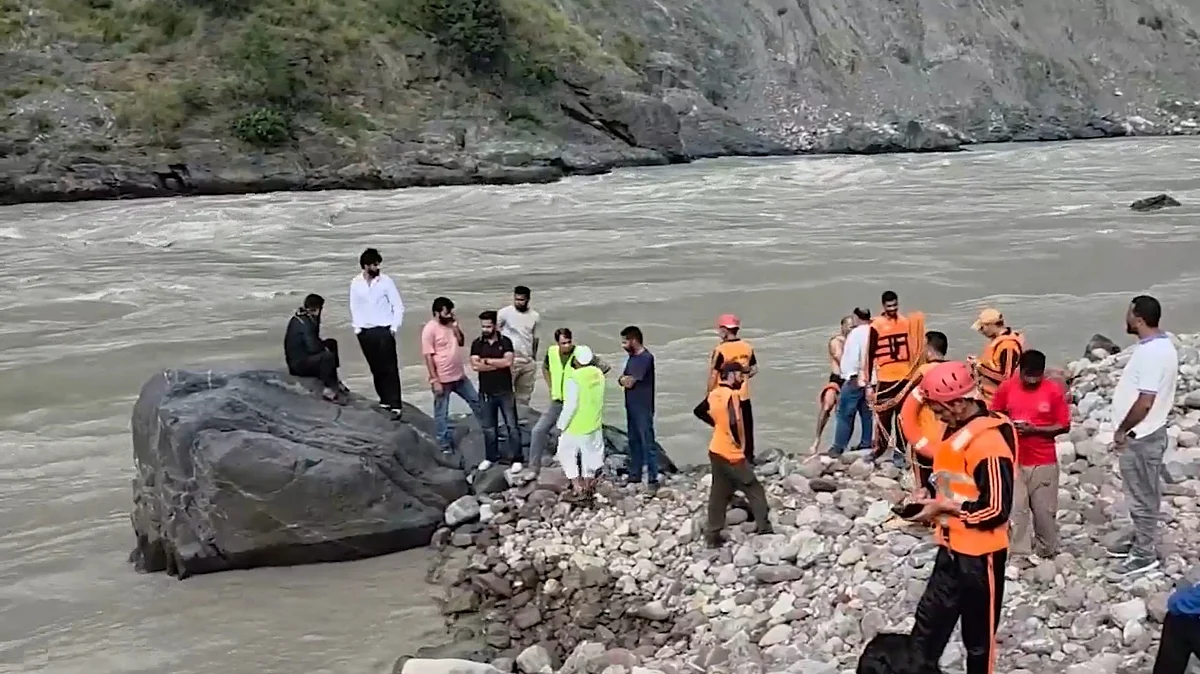
Rescuers battle flood debris, mud at Nepal hydropower tunnel as victims' families say ‘we still have hope’
Families of missing workers are pressing authorities to accelerate rescue efforts as teams struggle to remove mud and debris blocking tunnels.

The flash flood in Nepal and Tibet on August 26 wasn't an isolated incident, but rather a prelude to more disasters to come, researchers warn. Gunjan Silwal from Newcastle University explains that due to rapid warming in mountainous regions worldwide, "we can expect more of these events happening." The disaster in Nepal and Tibet was caused by the collapse of a glacier, along with a large landslide that included rock and ice.
Bethan Davies from Newcastle University states that the event was "not just a glacier detachment; it's like a large landslide with a glacier on top of it." The full extent of the water source remains unclear, but it is believed that the falling rock and ice landed on additional ice left by retreating glaciers, significantly contributing to the flood.
Researchers are debating the extent to which global heating contributed to the disaster, with Davies noting that the region is warming at a much faster rate than the global average. In fact, the temperature in the area has increased by 0.3°C per decade, compared to the global average of under 0.1°C per decade. This rapid warming, known as elevation-dependent warming, is a phenomenon observed in other mountainous regions around the world.
Davies believes that climate change likely played a significant role in the disaster, as the glacier involved in the event was part of a larger trend of retreating glaciers. The thinning and retreat of these glaciers may have destabilized the rock slope, leading to the collapse. Additionally, the degradation of permafrost could have contributed to the disaster, as the ice in cracks helps hold rocky slopes together and helps glaciers stick to their surfaces as they flow.
The fundamental problem is that the region is warming at an unusually high rate, making many glaciers in the area more vulnerable. Davies and Silwal highlight the fragmentation of smaller glaciers, which have lost their lower parts and are now perched higher up, similar to the glacier that collapsed in the disaster. The catastrophic wildfires in Europe serve as another example of the potential consequences of global heating, emphasizing the urgent need for action to reduce fossil fuel use and implement early warning systems to protect vulnerable communities.
Written by urgent.news from New Scientist's reporting — not their text. Machine-written — may contain errors; check the original before relying on it.
This story
This is one outlet's version. Read the fullest account.
- Nepal death toll crosses 1,000 as rescuers race to find workers trapped in mud-filled tunnels kahawatungu.com
- Nepal flood death toll reaches 939, rescuers push on dailytimes.com.pk
- Nepal death toll crosses 1,000 as rescuers race to find workers trapped in mud-filled tunnels gbcghanaonline.com
- Nepal flood death toll crosses 1000, nearly 4000 still out of contact iol.co.za
- Hundreds of Nepal flood survivors trapped near hydroelectric plant cbsnews.com
- Nepal flood death toll rises to 1,050 as rescue efforts continue english.ajel.sa
- Nepal death toll crosses 1,000 as rescuers race to find workers trapped in mud-filled tunnels myjoyonline.com
- Nepal flood: Death toll tops 1,000 as rescue continues dw.com