Do we live inside a baby universe that’s really a black hole on the outside?
One of the biggest existential questions that has puzzled humanity for as long as humans have been around is simply, “Where did all this come from?” After countless centuries of wondering and speculating, the 20th century brought with it our first scientific answers to that question. We learned that distant objects in the Universe are speeding away from one another: evidence that our Universe is…
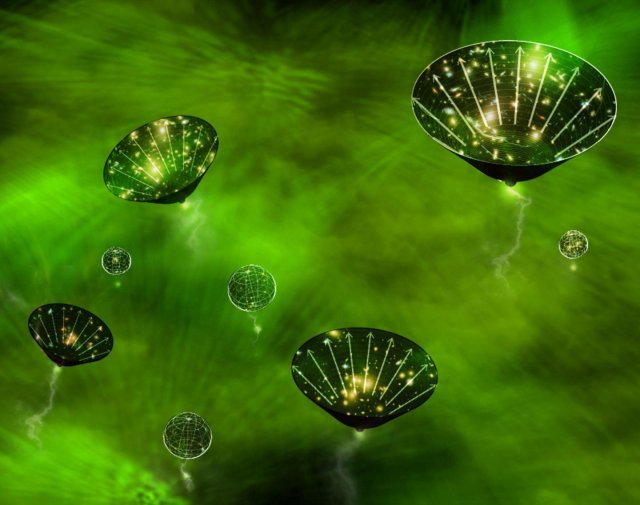
The origin of the Universe has long intrigued humanity, with 20th-century science providing the first scientific answers. Evidence such as the expansion of distant objects, evolution of galaxies over time, and the cosmic background radiation indicated that our Universe originated from a hot Big Bang approximately 13.8 billion years ago.
However, a curious aspect of our Universe is that if the mass and energy of all particles within the visible Universe were combined, the resulting event horizon of a black hole would be nearly the same size as the cosmic horizon we observe. This has led to the intriguing idea that our Universe could have been formed from a black hole created within a larger "parent Universe."
When crossing the event horizon of a black hole, time appears to slow down, and a person inside would reach the singularity within seconds. Outside the event horizon, other forces can counteract gravity, allowing matter to escape. As we add up the mass and energy of all particles in the observable Universe, including normal matter, dark matter, neutrinos, photons, and gravitational waves, we find that the resulting "mass" is almost equivalent to the Schwarzschild radius of a black hole containing the entire mass of our Universe.
This raises the question of whether our Universe might have been born from a black hole within a larger "parent Universe."
Written by urgent.news from Big Think's reporting — not their text. Machine-written — may contain errors; check the original before relying on it.