Why NASA's new telescope could revolutionise our understanding of the universe
NASA has successfully launched its newest space telescope from Kennedy Space Center in Florida. It reached orbit ten minutes after liftoff. Named after astronomer Nancy Grace Roman, scientists are calling it a discovery machine. It could also shed light on two of physics biggest unsolved mysteries - dark matter and dark energy.
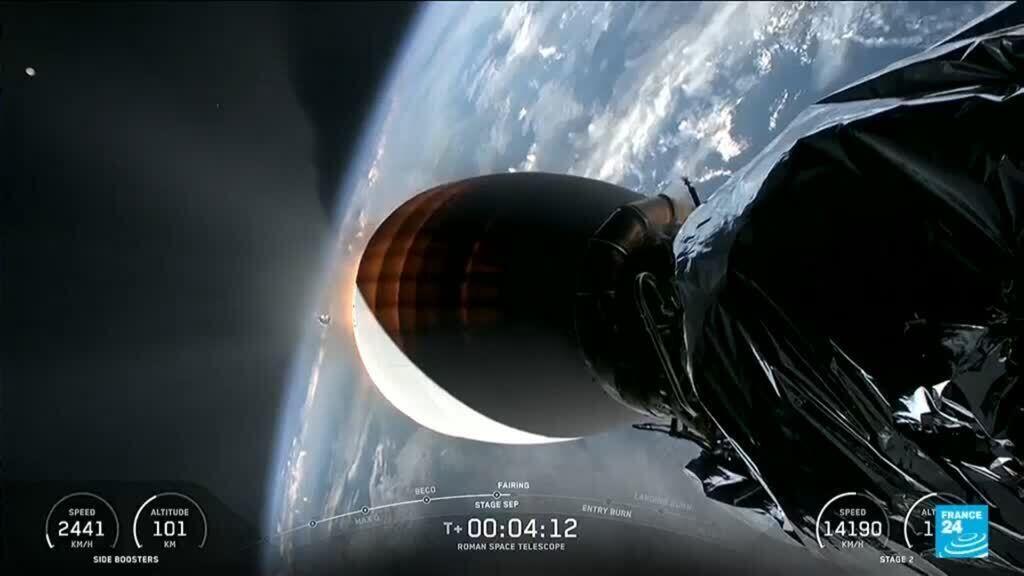
NASA's Nancy Grace Roman Space Telescope embarked on a three-month journey extending about one million miles to reach its final orbit. The observatory was launched at 7:26 a.m. EDT Sunday from NASA's Kennedy Space Center in Florida using a SpaceX Falcon Heavy rocket. Once fully operational, Roman's sharp infrared vision combined with a vast sky coverage will enable astronomers to explore enormous regions of space and delve deep into cosmic history.
Its primary objectives include studying dark matter, dark energy, and exoplanets. Roman's wide-ranging observations are also anticipated to yield numerous discoveries beyond these main goals. NASA Administrator Jared Isaacman lauded Roman as a success story, highlighting its timely delivery and budget adherence. The telescope will provide a new cosmic atlas, push discovery boundaries, and showcase what is achievable when America's space program combines bold ambitions with disciplined execution.
NASA's Associate Administrator for the Science Mission Directorate, Nicky Fox, emphasized Roman's role in answering profound questions about cosmic history. The telescope's large field of view and rapid survey speeds will usher in a new era of discovery, making the invisible visible and laying the groundwork for the search for life beyond our solar system.
During the mission's initial stage, Roman communicates with ground controllers via the Near Space Network, transitioning to NASA's Deep Space Network for guidance toward the second Sun-Earth Lagrange point, roughly one million miles away. The telescope's solar panels, lower instrument sun shade, high-gain antenna, and visor-like deployable aperture cover have all deployed successfully.
Controllers performed a course correction one hour and 23 minutes post-launch, and the Coronagraph Instrument, capable of imaging Earth-like planets, will be activated a few weeks into the journey. Roman's main scientific instrument, the Wide Field Instrument, a 300 megapixel infrared camera, will also be switched on soon. The telescope is designed to survey the universe about 1,000 times faster than the Hubble Space Telescope, enabling the study of vast numbers of celestial objects in significantly less time.
Scientists and engineers will meticulously test and calibrate Roman's instruments during the commissioning period, ensuring optimal performance before the full science program begins. The telescope is expected to transmit roughly 1.4 terabytes of data daily to Earth, a record-breaking data rate for a NASA astrophysics mission. Machine learning, artificial intelligence, and citizen scientists will aid in analyzing this data, identifying potentially significant discoveries, and allowing astronomers to delve deeper into the most promising findings.
Written by urgent.news from ScienceDaily's reporting — not their text. Machine-written — may contain errors; check the original before relying on it.