Urgent.News

What's breaking now, across thousands of outlets.

World

Early morning fire in Kota Kinabalu squatter area, 39 personnel deployed to contain blaze

KOTA KINABALU, Aug 30 — A fire broke out at stilt houses in a squatter area in Kampung Numbak here early this morn...
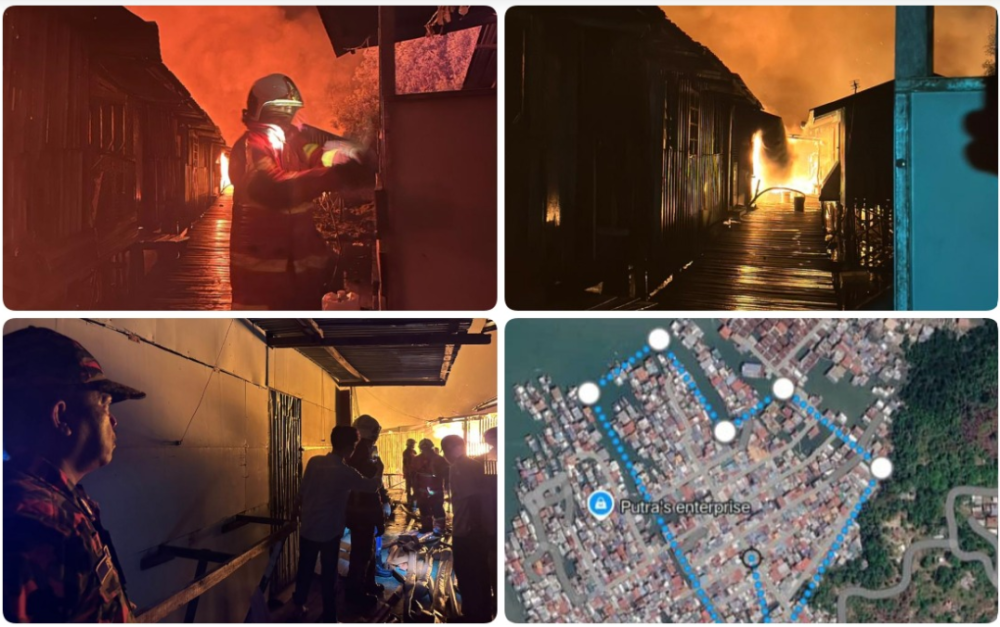
Early morning fire in Kota Kinabalu squatter area, 39 personnel deployed to contain blaze

KOTA KINABALU, August 30 — A fire erupted in a squatter area of Kampung Numbak early this morning, with the exact number of affected stilt houses still undisclosed as firefighters continue their efforts to control the blaze. The Sabah Fire and Rescue Department (JBPM) reported receiving an emergency call at 1:40 am, triggering a rapid response from firefighters.

They arrived at the scene, situated 18 kilometers away, at 1:58 am. According to the JBPM, a total of 39 personnel, drawn from the Kota Kinabalu, Lintas, and Penampang Fire and Rescue Stations (BBP), were deployed to the site to combat the fire. Firefighters utilized two streams and four water jets, with water supplied by the fire engines.

The battle against the flames is ongoing, and additional details on the incident will be released as they become available. So far, no reports of victims have been received, and the Royal Malaysia Police (PDRM) along with other pertinent agencies are supporting the firefighting operations.

Written by urgent.news from Malay Mail's reporting — not their text. Machine-written — may contain errors; check the original before relying on it.

This story

This is one outlet's version. Read the fullest account.

Read the original at malaymail.com →

More in World

The Imperial Family Law: Is Male-Line Succession a Tradition? What Would "Discoverer" Inoue Kinji Think Now? The issue of imperial succession has been a topic of discussion in Japan, with some arguing that the current male-line succession system is a tradition that should be preserved, while others argue that it is not supported by historical evidence. Inoue Kinji, a Japanese politician and historian, played a key role in the creation of the Imperial Family Law of 1889, which established the current male-line succession system. At the time, Inoue was serving as the Minister of Education in the Meiji government. The law was modeled after the Prussian royal family's system, which was seen as a modern and Western-style approach to imperial succession. However, some historians argue that Inoue and others who supported the male-line succession system did so based on a misunderstanding of Japan's historical traditions. They point out that, in fact, the Japanese imperial system has historically been characterized by a complex and nuanced approach to succession, with women and adoptees often playing important roles. If Inoue Kinji were alive today, it is unclear what he would think about the current debate over imperial succession. Some might argue that he would continue to support the male-line succession system, seeing it as an important part of Japan's modernization and Westernization. Others might argue that he would be open to revising the system, recognizing that Japan's historical traditions are more complex and multifaceted than he initially thought. Regardless of what Inoue might think, the debate over imperial succession is likely to continue, with implications for the future of the Japanese monarchy.

More from Sunday 30 August →