NASA’s Nancy Grace Roman Space Telescope Has a Hidden Technological Leap
Astronomers will test equipment that, if it’s successful, will one day be crucial for discovering Earthlike planets.
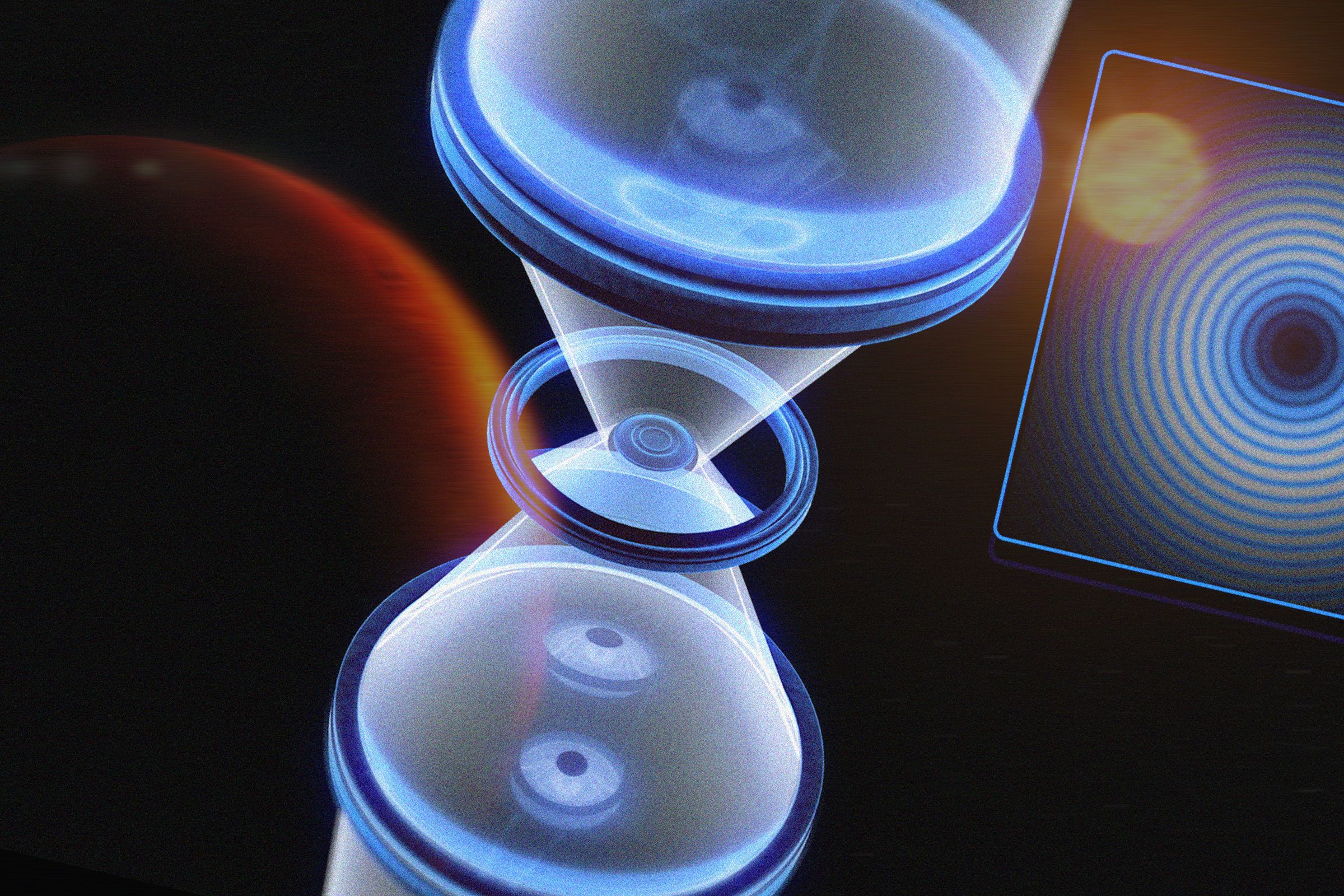
NASA’s Nancy Grace Roman Space Telescope is set to launch soon, and within the telescope lies a groundbreaking experimental device known as a coronagraph. This specialized tool will attempt to directly capture starlight reflected off a planet’s surface for the first time, a feat that could provide a glimpse of an Earth-like planet orbiting a sun-like star.
While this isn’t an easy task—NASA likens the challenge to photographing a firefly next to a floodlight from across the country—Roman’s coronagraph is designed to overcome it. The telescope is equipped with adaptive optics technology, which deforms the telescope’s mirror to cancel out light distortions, making it more precise than any previous coronagraphs.
However, adaptive optics is standard on advanced ground-based telescopes, and space telescopes typically don’t need it. Nevertheless, Roman’s coronagraph uses two small mirrors, each embedded with about 2,300 tiny actuators that reshape to reverse atmospheric interference. The coronagraph also employs exquisitely detailed star shades, or masks, that are unlike anything currently in space.
Scientists will test the coronagraph by attempting to spot a few known exoplanets, and by observing stars surrounded by dust or debris, they may discover gaps caused by undetected planets. The data gathered will provide valuable insights for future telescopes, including the Habitable Worlds Observatory and the Lazuli Space Observatory, both of which will require even more effective coronagraphs.
While the primary goal is to find alien worlds, coronagraphs could also reveal binary stars or objects hidden near bright quasars, contributing to our understanding of the universe.
Written by urgent.news from Wired's reporting — not their text. Machine-written — may contain errors; check the original before relying on it.
Also reported by 8 other outlets
- SpaceX Launching NASA's Roman Space Telescope to Explore Dark Energy and Habitable Planets science.slashdot.org
- NASA’s Roman Space Telescope: Falcon Heavy Passes Max Q science.nasa.gov
- What is the Nancy Grace Roman Telescope? thehindu.com
- NASA’s Nancy Grace Roman Telescope Promises a Breakthrough in Cosmic Exploration nytimes.com
- The Nancy Grace Roman Space Telescope Will Now Travel Almost One Million Miles to Reveal Mysteries of the Universe discovermagazine.com
- NASA’s Nancy Grace Roman Space Telescope Has a Hidden Technological Leap wired.com
- Nancy Grace Roman Space Telescope Launches this Sunday npr.org
- Nasa Roman Space Telescope launch today: Time, mission and key details indianexpress.com