Skin, burial mounds and AI: Six NYUD artists rethink memory and belonging in Abu Dhabi
The aquariums rev and babble, motors circulating water despite their empty state. Their black steel frames vibrate. Their glass panes are coated with a salty residue from the receding waterline but also, perhaps, from what once lived within. Two round, vertical containers are set beside the aquariums. Filled with a murky liquid, they are tall and wide enough to hold a person. Again, they are…
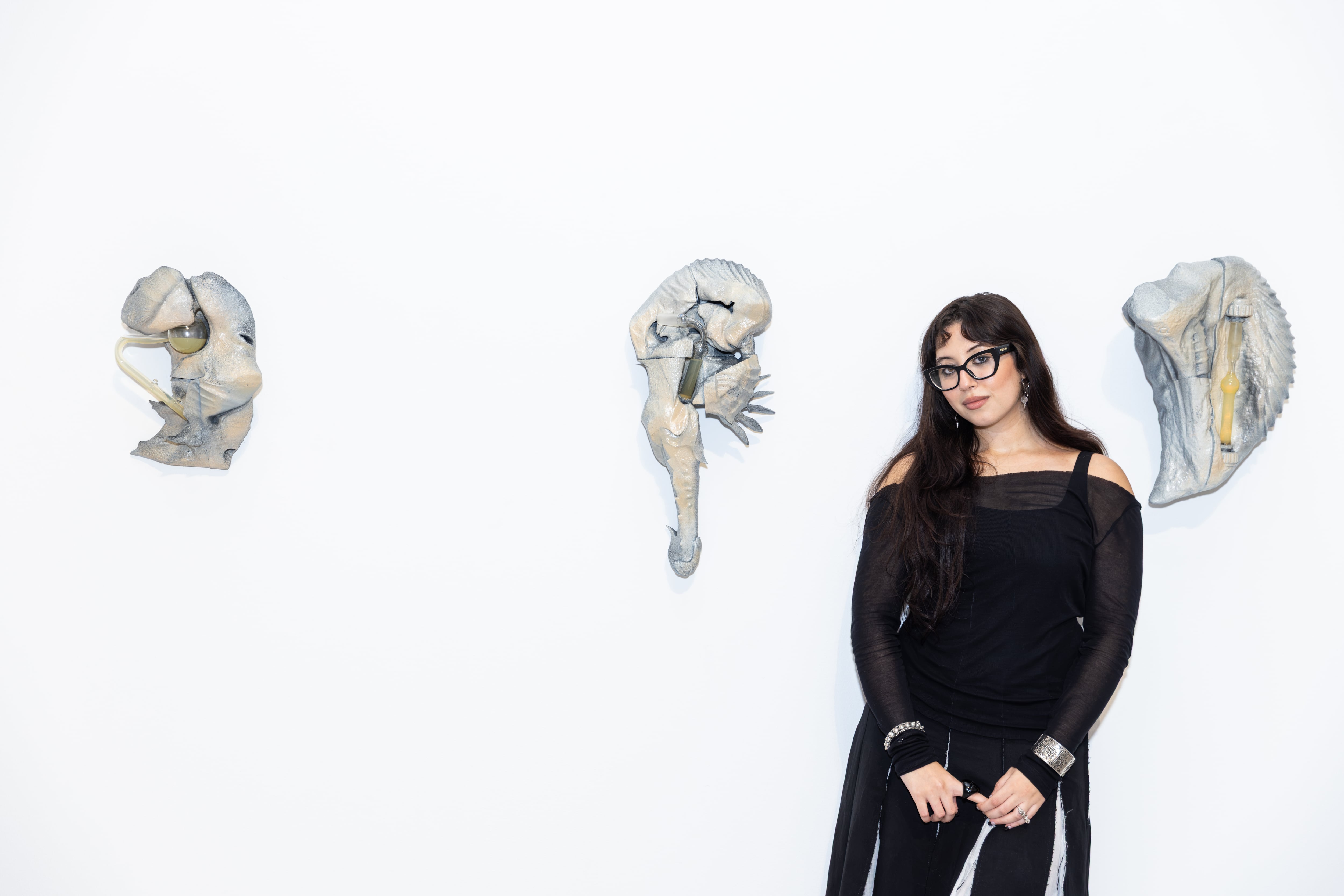
Six New York University Abu Dhabi (NYUD) artists have collaborated on a unique exhibition titled Mutable Devotions, currently on display at the Rizq Art Initiative in Abu Dhabi. The exhibit explores themes of memory, belonging, and the relationship between humans and nature.
One of the installations, Nour Elbery's "Set Dressing for an Afterimage," draws inspiration from the Aquarium Grotto Garden in Cairo. The grotto, originally built in 1871 as a private space for Khedive Ismail, was filled with aquatic life and designed to mimic the sounds of the sea. Over time, it was converted into a more menacing enclosure for life on the Nile, now empty of live fish.
Elbery's installation uses shavings of her own skin, preserved in formalin, to symbolize the containment of what should not be contained. She explains that each work in the exhibition is less a vessel for something than a vessel for the memory of holding something.
Shaima Shamsi's "Notes on Being Swallowed by a Cavity" also references historical attempts at containing and plundering the natural world. Her work features 170 ceramic tiles arranged in a grid on the wall, each uniquely colored and creased. Shamsi draws inspiration from British geological surveys conducted in the Arabian Peninsula, particularly a 1908 publication by British geologist Guy Ellcock Pilgrim, which mentions burial mounds in Bahrain.
These mounds, dating back to between 2200 and 1750 BCE, are believed to be from the ancient Dilmud civilization and are now listed as UNESCO World Heritage sites. Shamsi's installation questions the imposition of human-made systems upon the natural landscape, as well as the preservation of ancient sites through absence.
Maha Alasker's installation "Was the Maternal Cord to my Land Cut Before I was Born?" presents a room filled with banana peels, hair, and ceramics, creating an altar-like space dedicated to womanhood and female forms. The room is adorned with rust-printed patterns on the floors and walls, forming an asemic language applied with ritualistic alliteration.
This work contrasts with Yuehan Dai's installation, which delves into the digital world to question the nature of humanity. Dai's piece employs verification systems, such as Captcha challenges and AI agents observing human behavior, to determine what constitutes a human. In contrast, Almaha Jaralla's multidisciplinary installation named "Agraba" scrambles the past and present in a fictional realm, featuring billboard-sized paintings that evoke a sense of history and memory.
Written by urgent.news from The National UAE's reporting — not their text. Machine-written — may contain errors; check the original before relying on it.
This story
This is one outlet's version. Read the fullest account.