SADC faces deeper El Niño food-security threat as neighbours lack grain buffers
El Niño could spell disaster for food security in the Southern African Development Community, with neighbouring countries lacking the buffers that South Africa has. As the region braces for potential drought, the implications for grain supply and prices could be severe.
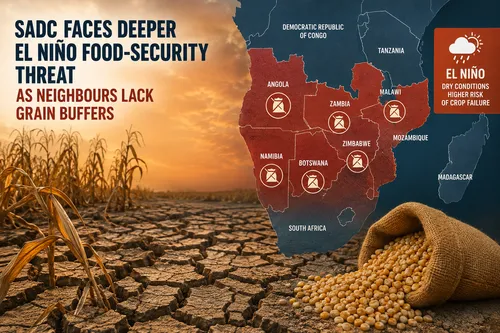
The Southern African Development Community (SADC) may face a more severe food-security crisis than South Africa if the upcoming growing season is affected by El Niño-induced drought. While South Africa anticipates a record maize harvest, along with ample carry-over stocks, greater soil moisture, and higher dam levels, neighboring nations lack similar buffers to protect against potential shortages.
Several countries, including Zimbabwe, Botswana, and Namibia, have already begun importing South African grain, signaling inadequate domestic supplies to meet annual needs. With neighboring nations concluding their own harvests, there will be limited time to address another poor harvest or price surge.
Agriforum chief economist Wandile Sihlobo cautioned that regional grain demand could surge in 2027 if the subsequent harvest underperforms. He stressed, "Clearly, the pressures and demand for grain and other agricultural products will likely be strong in 2027 in the sub-Saharan Africa region." South Africa may retain its capacity to export maize, but reduced production in multiple SADC countries would heighten competition for available supplies, potentially driving prices upward.
While East Africa might enjoy better rainfall, Kenya is unlikely to generate enough grain to compensate for any regional shortages, according to Sihlobo. During the 2015/16 El Niño drought, maize imports from Mexico temporarily alleviated the shortage. A similar situation could arise once more, leaving participating countries more vulnerable to exchange-rate fluctuations, freight costs, and port or inland transport inefficiencies.
Sihlobo expressed uncertainty about whether the World Food Programme would possess sufficient funding to provide comparable assistance during a regional crisis, as concerns have surfaced regarding potential reductions in U.S. aid affecting its resources.
Professor Richard Mkandawire, the founding chairperson of the MwAPATA Institute, emphasized the necessity for governments to fund preparations before a drought transforms into a humanitarian emergency. He advocated for national and regional financing, coordination involving governments, researchers, farmers' organizations, and the private sector.
Preparation should extend to provincial and district authorities, where emergency measures would be executed. Beatrice Makwenda from TrustAfrica suggested that resilience planning must be prioritized by those who bear the risk. Smallholder farmers, who generally have limited access to finance and insurance, bear the brunt of losses when harvests fail.
She remarked, "When that harvest fails, it's usually the farmer that really absorbs this loss." Without early investments in grain logistics, drought-resistant agriculture, soil health, water management, and household support, an agricultural shock could escalate into a regional affordability and hunger crisis.
Written by urgent.news from IOL's reporting — not their text. Machine-written — may contain errors; check the original before relying on it.