The act of measuring reality alters what you’ll observe
When we divide up matter into the smallest possible chunks that it’s made of — into the stuff that can be divided or split no further — those indivisible things we arrive at are known as fundamental particles: the elementary quanta that compose our Universe. But unlike the macroscopic, familiar objects that make up our world, we can’t simply assign definitive properties to them like “position”…
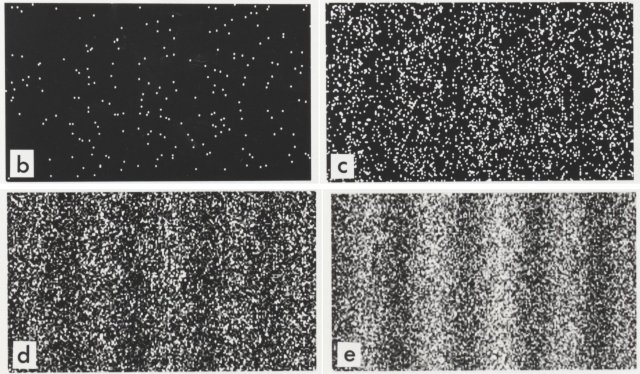
In the realm of quantum mechanics, observing the behavior of the tiniest building blocks of the universe — fundamental particles like elementary quanta — alters the outcome of the experiment. These indivisible entities, the quanta, can exhibit either particle-like or wave-like properties depending on how they are measured or even if they are observed at all.
The double-slit experiment, first performed by Thomas Young in the early 1800s, serves as a prime example of this phenomenon. Young's experiment demonstrated that light could behave both as a particle and as a wave, producing interference patterns on a screen behind two slits. When electrons were fired instead of light, the same interference patterns emerged, further illustrating the dual nature of quantum objects.
Intriguingly, when individual electrons were fired one-at-a-time through the double-slit, the interference pattern still appeared after thousands of electrons passed through. This led scientists to wonder if each electron was somehow interfering with itself, a notion that defied conventional understanding. By introducing a light source to detect through which slit each electron passed, researchers found that the interference pattern vanished.
It appeared that observing the electron's path negated its wave-like behavior, and the electron acted as if it were a particle.
This paradoxical behavior — where measuring the quantum object influences its properties — continues to perplex physicists to this day. The double-slit experiment stands as a testament to the peculiar nature of quantum mechanics, where the act of observation itself holds the power to shape the reality we observe.
Written by urgent.news from Big Think's reporting — not their text. Machine-written — may contain errors; check the original before relying on it.