For the First Time, a Selection of Islamic Masterpieces From the Louvre Is Coming to the United States. See the Treasures Soon to Be Displayed at the Smithsonian's National Museum of Asian Art
Twenty-six works spanning many centuries and regions will form the September exhibition titled "From the Louvre: Masterpieces of Islamic Art"
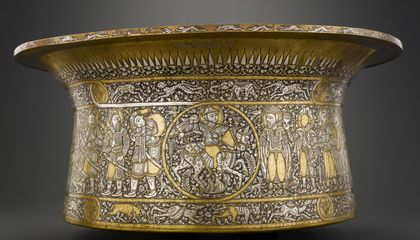
The Smithsonian's National Museum of Asian Art is set to host a unique exhibition, "From the Louvre: Masterpieces of Islamic Art," featuring 26 Islamic masterworks from the Louvre in Paris. Opening on September 26 and on display until January 18, 2027, the exhibition includes artifacts spanning from the 7th century to the 19th century, originating from regions as diverse as Spain and India. This marks the first time these 26 masterpieces will be exhibited together in the United States.
Curated by Simon Rettig of the Asian Art museum and Souraya Noujaim of the Louvre, the exhibition highlights a wide array of Islamic world artifacts, crafted from bronze, wood, ceramics, and other materials. Visitors can expect to see a stunning 14th-century Syro-Egyptian Baptistery of Saint Louis basin and a 17th-century Mughal dagger made with Damascus steel, inlaid with gold and featuring a horse head handle.
Rettig, the curator of Islamic art at the museum, describes the basin as "an astonishing object, which is in pristine condition." He notes that while objects are often elevated to masterpiece status over time, this particular basin earned its status through the public and museum visitors' recognition.
The exhibition aims to encourage visitors to explore the journeys these objects have undertaken, despite many of their full histories remaining unknown. For instance, the Saint Louis basin, named after its association with Louis IX, was initially used for French royal baptisms. However, it was during the 18th century that the French created a "forged identity" for the basin as part of their culture.
It wasn't until the 20th century that the basin's Islamic roots were widely acknowledged, demonstrating that history is not linear and these objects carry multiple identities.
The exhibition underscores the museum's long-standing collaboration with the Louvre, dating back to 1903 when Charles Lang Freer, the founder of the Freer Gallery of Art (now part of the National Museum of Asian Art), visited a landmark Islamic art exhibition in Paris organized by Gaston Migeon, the Louvre's curator. Freer was profoundly inspired by this experience, leading him to start acquiring Islamic art and donate his collection in 1906, which was exhibited upon the opening of the Freer Gallery of Art in 1923.
The exhibition at the Smithsonian promises to offer visitors a deeper understanding of what makes a masterpiece a masterpiece.
Written by urgent.news from Smithsonian's reporting — not their text. Machine-written — may contain errors; check the original before relying on it.