A New Telescope Still Under Construction Accidentally Reveals How a Dying Star Returns Matter to Space
Researchers captured an unprecedented image of the stellar recycling process while calibrating a Chile-based instrument called MOTHRA, which is expected to be complete by the end of 2026
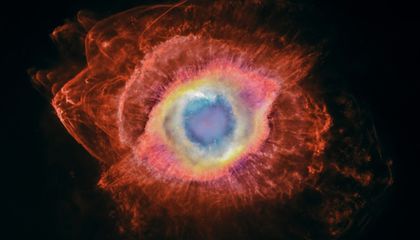
A telescope currently under construction in the Chilean Andes unexpectedly captured a striking image of a dying star releasing its remnants and dispersing them throughout the galaxy. Astronomers have long understood that stars, upon their demise, expel elements such as carbon, oxygen, and nitrogen into space, which subsequently contribute to the formation of new stars, planets, and other celestial bodies—including our own.
However, observing the dispersal and mixing of this expelled stellar material with interstellar gas had proven challenging until now. The discovery, detailed in the journal Nature on August 12, occurred accidentally while scientists were calibrating the Modular Optical Telephoto Hyperspectral Robotic Array, or MOTHRA, telescope in November 2025.
They aimed the telescope toward the Helix Nebula, a dying star situated approximately 650 light-years from Earth, which was an ideal target due to its size, brightness, and extensive study history.
According to study co-author Roberto Abraham, an astronomer at Canada's University of Toronto, they were calibrating the telescope for one of the most well-known nebulae in the sky when they stumbled upon an extraordinary network of bow-shaped structures. Abraham explained, "We thought we were taking a calibration image of one of the best-known nebulae in the sky.
Instead, we found this extraordinary network of bow-shaped structures. It was immediately clear that the faint outer Helix was telling us a story that had largely been missed."
The image reveals 22 complete or partial glowing arcs on the eastern outskirts of the nebula, referred to as bow shocks. These resemble the waves that form in the water in front of a moving boat. The arcs on the outer edges of the nebula, known as the halo, are large and sharply defined, whereas those farther away appear fuzzier. This difference is likely due to the star material gradually eroding and dissolving into the interstellar medium as it travels outward, a process estimated to take around 10,000 years.
The Helix Nebula, also catalogued as NGC 7293 or Caldwell 63, is often informally called the "Eye of God" or even the "Eye of Sauron" due to its striking resemblance to an eye. While researchers had previously identified some significant bow shocks around the Helix Nebula, these new observations offer insights into the interaction between stellar mass loss and the interstellar medium.
The observation is a glimpse into the capabilities of MOTHRA, which, upon completion by the end of the year, will utilize its array of lenses and specialized filters to photograph the faint glow of gas across vast sections of the sky. The researchers, as reported by Mary Randolph at Scientific American, aim to use this instrument to better understand the process of stellar recycling for other stars, including our sun, which is expected to begin its dying stage in about five billion years.
However, spotting similar bow shocks around other nebulae might be difficult as the Helix Nebula's speed relative to the surrounding gas conditions are ideal for creating visible bow shocks, a phenomenon that may not occur elsewhere. Despite this, MOTHRA is anticipated to uncover numerous surprises about our universe. Abraham remarked, "Even when you're building it, all you have to do is point it at anything, and cool things are going to emerge." However, the telescope's primary purpose is to comprehend how galaxies form and evolve.
Written by urgent.news from Smithsonian's reporting — not their text. Machine-written — may contain errors; check the original before relying on it.