NASA Begins Moon Mission Plume-Surface Interaction Tests
EDITOR’S NOTE: This story, originally published in December, was revised Aug. 26, 2026 with an update on a new phase of testing, including video from a recent test run and new images. To help NASA and commercial partners better understand the science of lunar landings, specifically the hazards that may occur when a lander’s engine […]

NASA has initiated a series of plume-surface interaction tests at its Langley Research Center in Virginia, aiming to better understand the science of lunar landings and the hazards that may occur during such activities. These tests are crucial for researchers to improve predictive models and influence the design of space hardware for NASA's plans to return humans to the Moon with Artemis IV in 2028 and develop a Moon Base.
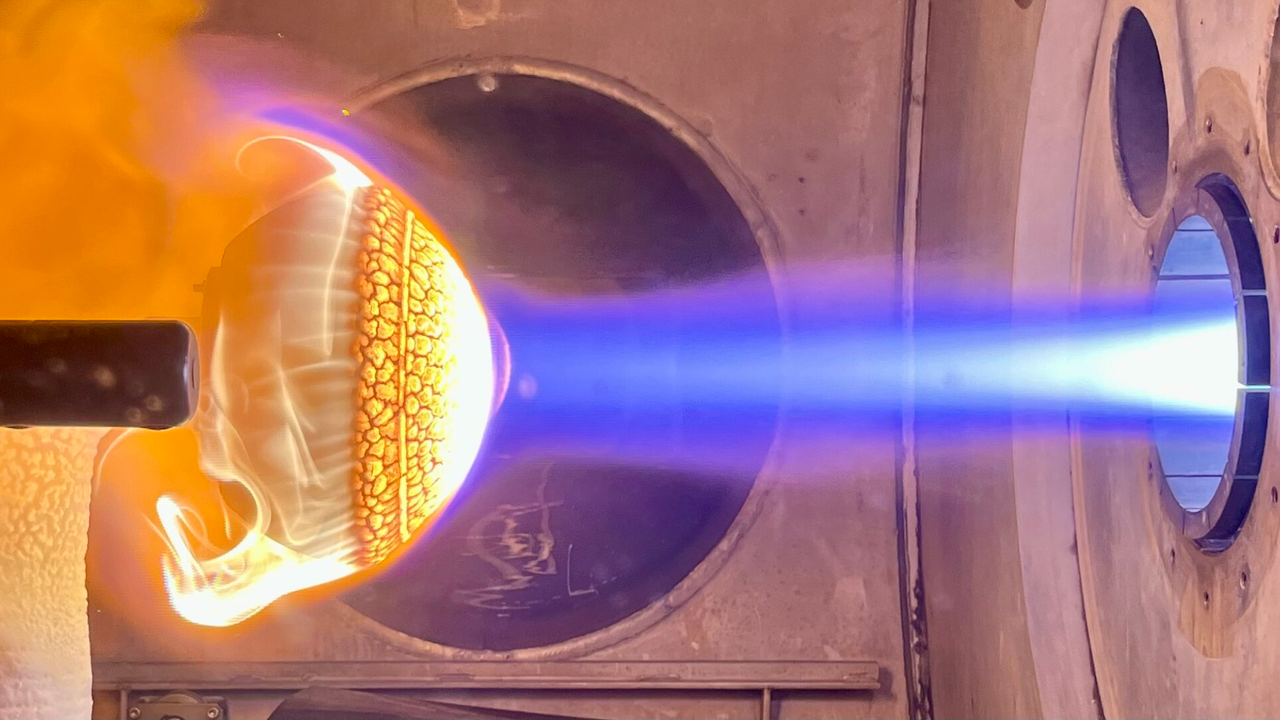
The tests are being conducted in a massive 60-foot spherical vacuum chamber, where a team from NASA Langley, along with academic institutions and commercial entities, will study the effects of a lander's engine plumes on lunar dust, soil, and rocks. The campaign involves two types of propulsion systems: an ethane plume simulation system and a 3D-printed hybrid rocket motor. The ethane system generates about 100 pounds of thrust, while the hybrid motor produces around 35 pounds of thrust.
The ethane system simulates the maximum thrust necessary to lift or support a 100-pound person, while the hybrid motor creates a hot, powerful stream of rocket exhaust. Both systems will be tested at various heights, providing a range of test conditions for spacecraft of all sizes. Researchers will measure various aspects such as crater formation, ejecta sheet angle and height, spatial distribution of solid ejecta, and the speed of regolith particles being blasted out of the test bin.
The modular design of the vacuum sphere allows for the replacement of lunar regolith simulant with a Mars simulant to prepare for future Martian missions. The sphere can also simulate Martian atmospheric pressure, making the tests applicable for both lunar and Martian landings.
Written by urgent.news from NASA's reporting — not their text. Machine-written — may contain errors; check the original before relying on it.
This story
This is one outlet's version. Read the fullest account.