NASA’s Nancy Grace Roman Space Telescope Arrives at Hangar
NASA’s Nancy Grace Roman Space Telescope arrived Tuesday to the SpaceX hangar at Launch Complex 39A at Kennedy’s Space Center in Florida, just days before its scheduled launch. The post NASA’s Nancy Grace Roman Space Telescope Arrives at Hangar appeared first on NASA Science .
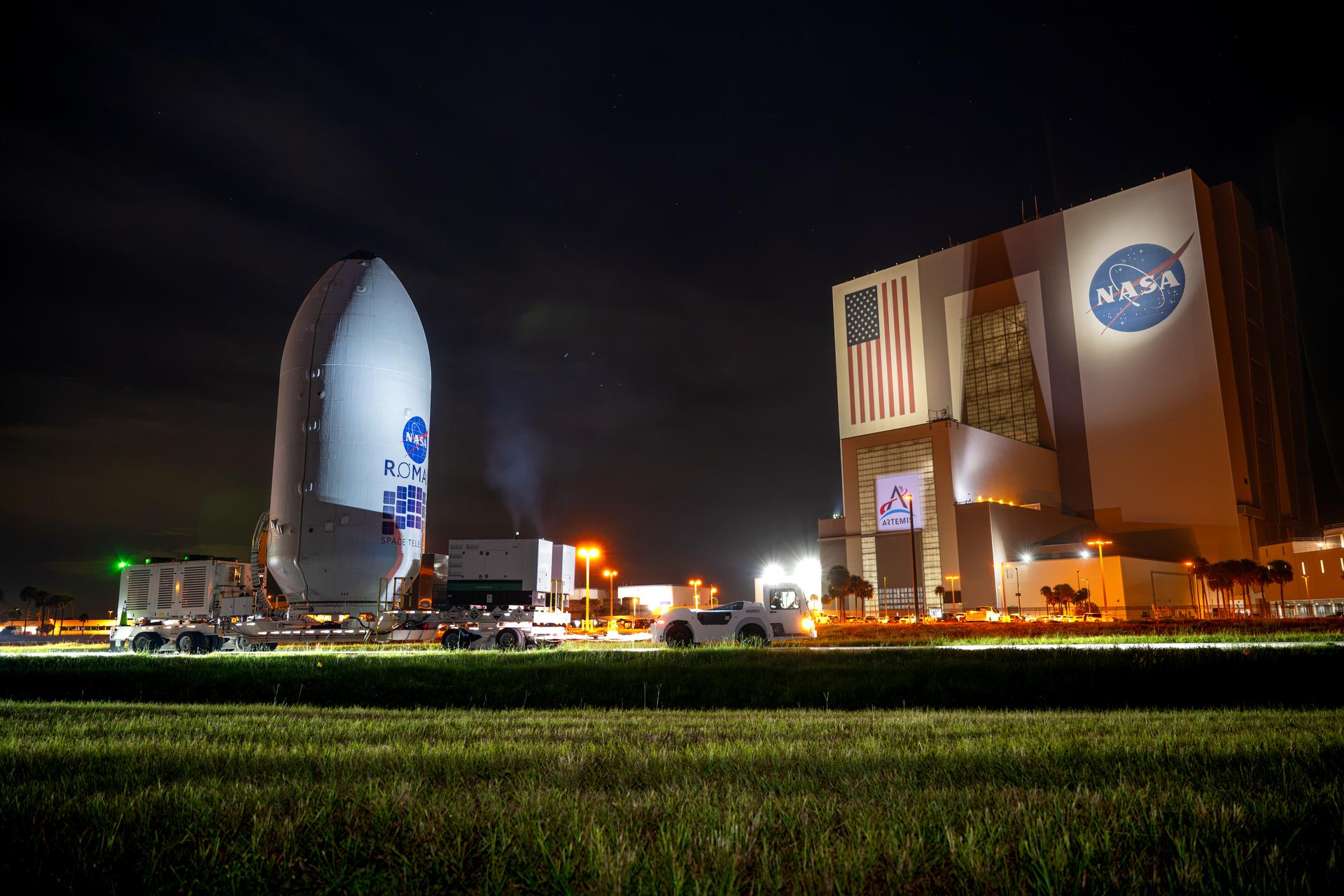
NASA’s Nancy Grace Roman Space Telescope arrived at the SpaceX hangar at Launch Complex 39A at Kennedy Space Center on Tuesday, Aug. 25, 2026, in preparation for its upcoming launch. The telescope, which began its journey on Aug. 24 from the Payload Hazardous Servicing Facility, was transported in Falcon Heavy’s fairing to ensure its safe arrival.
A convoy of vehicles escorted the telescope, monitoring its condition throughout the journey. In the days to come, the team will attach the Roman Space Telescope to the SpaceX Falcon Heavy rocket within the hangar. Mission operations are being managed by NASA’s Launch Services, which is handling the launch preparations for the fourth primary payload on a Falcon Heavy rocket since Psyche, GOES-U, and Europa Clipper.
One of Roman’s side boosters previously flew on the GOES-U mission. A Launch Readiness Review is scheduled for Friday, Aug. 28 to conduct the final “go/no go” vote ahead of the planned launch on Sunday, Aug. 30 from Launch Complex 39A at Kennedy. With a wide field of view, Roman will rapidly capture vast swaths of sky full of stars and galaxies after reaching the second Sun-Earth Lagrange point 2, or L2.
The telescope is designed to investigate dark energy, the mysterious force behind the universe’s accelerating expansion, and will also map the formation, clustering, and evolution of galaxies by tracing dark matter’s influence. Additionally, Roman will discover and study planets beyond our solar system with the precision required to create a statistical census of planetary systems in our galaxy.
Written by urgent.news from NASA Science's reporting — not their text. Machine-written — may contain errors; check the original before relying on it.
This story
This is one outlet's version. Read the fullest account.