Moon set to turn red as rare partial lunar eclipse graces UK skies
There will be a partial lunar eclipse in the UK on 28 August, and may cause the Moon appear reddish in colour.
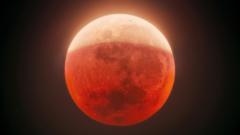
A rare partial lunar eclipse is set to grace the UK skies this week, casting the full Moon in an eerie reddish glow. This celestial event occurs when the Sun, Earth, and Moon align in the night sky, with the Moon entering the Earth's darkest shadow. During a partial eclipse, only a portion of the Moon enters this shadow, the umbral section. The Moon, however, remains partially lit by sunlight that has been scattered by the Earth's atmosphere, reflecting a reddish hue onto the lunar surface.
The eclipse, visible in the early hours of Friday, 28 August, will begin at 03:33 BST in London when the Moon enters the Earth's shadow. Its maximum point will be reached at 05:12 BST, with about 90% of the Moon within the umbra. The Moon, typically low in the south-western sky, will exhibit the Moon illusion—a phenomenon where the Moon appears larger than usual due to its position in the sky and the way our brains process visual information.
This effect is most noticeable during moonrise or moonset, when the lunar disc is viewed alongside familiar objects on the ground.
In London, the Moon is expected to set around 06:15 BST. Skywatchers are advised to find a high location with an unobstructed view towards the south-western horizon for the best chance of seeing the eclipse. Viewing conditions vary across the UK, with low pressure bringing cloud and heavy showers to some areas while others remain clear.
Currently, central and eastern parts of England and Wales offer the best viewing conditions, though cloud cover may change rapidly, making accurate forecasting challenging. Forecast updates can be checked online or through the BBC Weather app.
Written by urgent.news from BBC Science's reporting — not their text. Machine-written — may contain errors; check the original before relying on it.