Comet 220P McNaught Puts On An Encore Performance
It has been a busy month for astronomy. In the midst of an eclipse season bookended by the total solar eclipse on August 12th and the deep partial lunar eclipse coming right up this week on August 28th, an outbound comet hanging high in the dawn sky just refuses to die: 220P/McNaught.
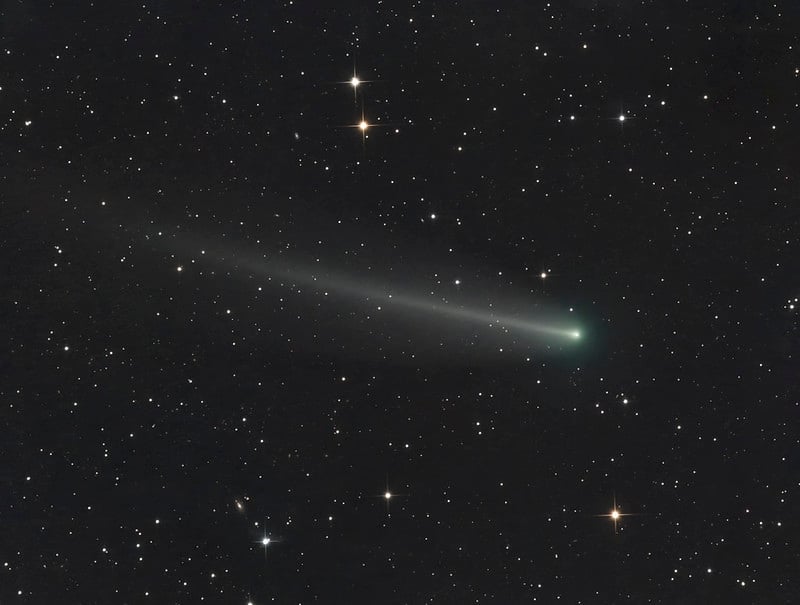
Comet 220P/McNaught has recently captured the attention of astronomers due to its recent outbursts and increased brightness. This periodic comet, first discovered by Robert McNaught in 2004, orbits the Sun every 5.5 years and is a Jupiter-family member caught in a 2:1 resonance with Jupiter. Its closest approach to the Sun, known as perihelion, occurred in June 2026, with the comet now located in the dawn sky.
In early June, the comet experienced a significant eruption, increasing its brightness by 10 magnitudes, which is equivalent to an 8,000-fold increase in luminosity. This was followed by another notable brightening of 600 times, or about 7 magnitudes, in early August. Despite this dramatic increase, the comet is still visible to the naked eye and can be observed through binoculars and small telescopes.
Astronomer Dan Bartlett has been tracking the comet and creating a sequence of images to showcase its evolution throughout the summer. The comet's appearance varies significantly from night to night, demonstrating its unique and unpredictable behavior. As the comet continues its journey through the inner solar system, it will make its closest approach to Earth on October 12th, passing at a distance of 1.043 AU. This will be a prime viewing opportunity for astronomers and stargazers alike.
Written by urgent.news from Universe Today's reporting — not their text. Machine-written — may contain errors; check the original before relying on it.