CI/CD for AI-Enabled Applications: Why Traditional Deployment Pipelines Need to Evolve
Traditional CI/CD pipelines are optimized around a familiar assumption: source code changes, automated tests validate the change, a build artifact is produced, and the application is promoted through environments. AI-enabled applications complicate that model because production behavior can change even when application code does not. A new model version, feature transformation, prompt…
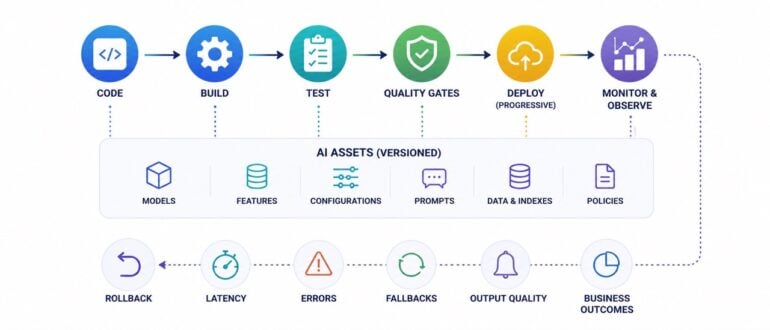
Historically, Continuous Integration Continuous Deployment (CI/CD) pipelines have operated under the assumption that code changes alone dictate application behavior. However, this model breaks down when applied to AI-enabled applications, where production outcomes can fluctuate based on factors beyond just the application code, such as model versions, feature transformations, or data schemas. To address this, teams must treat AI assets as integral components in the release process, rather than secondary components.
Versioning should encompass more than just the application itself. For traditional services, a commit ID and container image suffice for reconstruction. Yet, AI-enabled services necessitate tracking additional elements like model versions, feature definitions, inference configurations, policy rules, and data schemas. This ensures that if production behavior deviates due to an AI-related change, the team can trace it back effectively.
Without such a rigorous tracing mechanism, incident response becomes excessively challenging and speculative.
Unit, integration, and security tests remain crucial, yet they are insufficient for AI deployments. Additional testing mechanisms are required to validate the AI path's behavior and dependencies. This includes schema validations, checks for feature availability, model-load tests, assessments of inference latency, verification of output-range compliance, and regression tests using representative scenarios.
The aim is not to ensure absolute correctness but to identify changes that are evidently unsafe, incompatible, or operationally unacceptable before they go live. It is also imperative to differentiate between deterministic tests, which verify exact expected values, and statistical tests, which assess quality thresholds or benchmark comparisons—tests that are more relevant for AI outputs.
Before promoting a new model release, it's essential to evaluate operational fitness. A model might perform well in testing scenarios but introduce significant performance issues, such as excessive memory usage, increased inference latency, or higher downstream calls under heavy traffic. Therefore, performance tests, resource checks, and concurrency tests should be part of the CI/CD pipeline to ensure that new AI components meet the service’s latency and cost requirements.
This is particularly critical when model changes are introduced independently of application code updates. The pipeline should not rely solely on improvements in accuracy metrics, as these do not guarantee safety in production.
Progressive delivery mitigates the risk associated with big-bang AI releases. By gradually rolling out a new model or AI configuration to a small subset of users, teams can compare performance metrics—like latency, error rates, fallback rates, and business outcomes—against the existing version. Shadow deployments are a valuable technique in this regard, where the new model processes live traffic without influencing customer-facing decisions.
This allows teams to observe real-world performance and make informed decisions about full deployment or rollback. The release mechanism must clearly define and allow for reversible traffic allocation, ensuring quick reversion if new versions cause unexpected issues.
Rollback in AI systems is more intricate than in conventional applications due to the involvement of multiple components like model versions, feature transformations, caches, and downstream schemas. Before deployment, teams must be aware of which assets must move together and which can be reverted independently. Utilizing model registries, immutable artifacts, and compatibility rules helps streamline this process.
Additionally, separating the model serving layer from the core business application, especially when they follow different release cadences, simplifies the rollback procedure.
Lastly, it is vital to connect deployment telemetry to actual business behavior. While a successful deployment should return HTTP 200 responses, AI systems require additional indicators to confirm that the release is producing acceptable decisions. Monitoring should encompass application errors, infrastructure health, model latency, feature failures, output distributions, and fallback usage.
When feasible, these signals should be linked to downstream outcomes to detect potential degradation in behavior despite technical health. Clear ownership across DevOps and MLOps teams is essential, defining responsibilities for model promotion, acceptance thresholds, feature dependencies, and rollback decisions. Lastly, framing AI delivery as a supply chain of versioned components—comprising code, models, data contracts, configurations, and policies—provides a holistic view that aids in reproducibility, testing, and observability.
This approach enables the rapid deployment benefits of DevOps while addressing the unique control requirements of AI production environments.
Written by urgent.news from DevOps.com's reporting — not their text. Machine-written — may contain errors; check the original before relying on it.