Why Recycling Old Artificial Turf Fields Is So Difficult — and How Denmark Is Doing It
Artificial turf fields have transformed sports facilities across the United States and around the world, allowing athletes to play year-round with less water and maintenance than natural grass. But once those plastic fields wear out, a difficult question remains: What happens to all that artificial grass? The answer is complicated. Recycling worn-out artificial turf remains […]
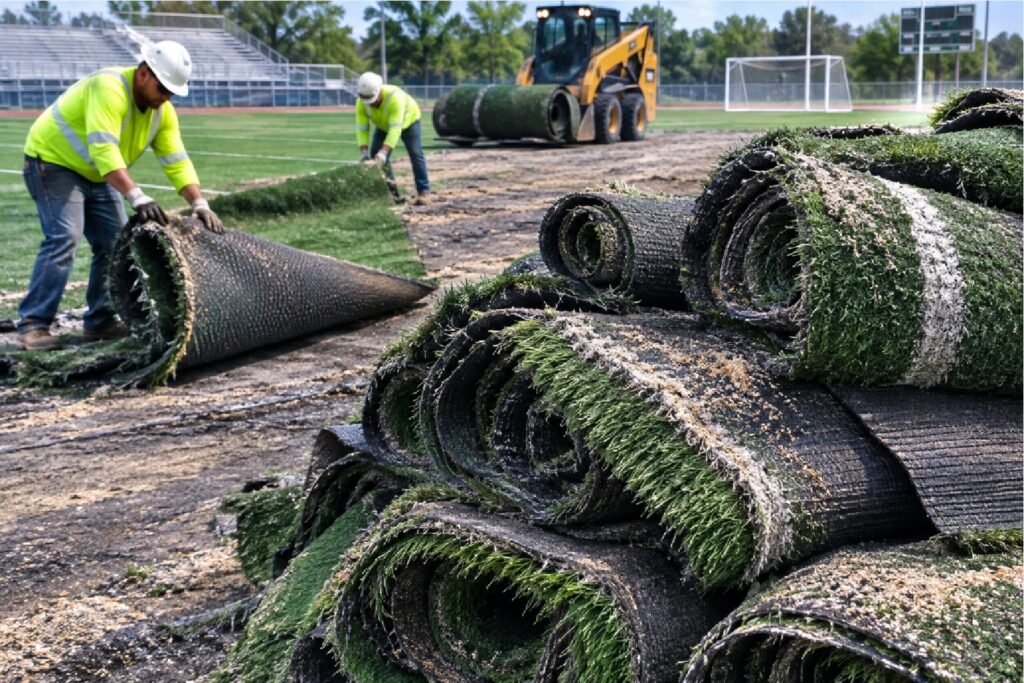
Artificial turf fields have revolutionized sports facilities worldwide by enabling year-round play with less water and maintenance compared to natural grass. However, the end-of-life disposal of these plastic fields remains a complex issue. Recycling worn-out artificial turf is expensive and technically challenging, with many old fields currently ending up in landfills or undergoing energy recovery. Denmark has emerged as a leader in developing a more advanced approach to recycling synthetic turf.
The difficulty in recycling artificial turf lies in its diverse composition. Conventional synthetic turf systems typically consist of polyethylene or polypropylene fibers, backing materials such as polypropylene, polyurethane, or latex, sand, rubber, or other infill, and sometimes shock pads. Over time, these materials become contaminated with dirt, dust, rubber particles, and other substances, and deteriorate due to exposure to sunlight, rain, and temperature fluctuations.
A 2026 study in the Journal of Environmental Management highlighted that separating the carpet, performance infill, and stabilizing infill, along with their various polymer fractions, is crucial for producing high-quality recycled materials. However, the complex process remains both technologically and economically demanding.
The scale of the problem is significant. An EU-funded project reported that around 50 million square meters of sports turf were disposed of globally in 2017, with this number expected to increase substantially. Historically, landfilling and incineration were the primary end-of-life options. In the United States, the lack of a widespread infrastructure for recycling complete synthetic turf systems has been a major challenge.
A 2024 report from Montgomery County, Maryland, found that recycling synthetic turf was expensive and difficult due to the difficulty in separating its materials, with many old fields ending up in landfills and U.S. recycling technology not yet capable of handling all the components of synthetic turf.
Nevertheless, the situation is gradually improving. A 2026 document from Natick, Massachusetts, noted that true artificial turf recycling is relatively new in the U.S., with only a few options available nationally. It identified a mechanical recycling facility in Rockland, Massachusetts, which began operations in July 2025 and is the first U.S. facility capable of mechanically recycling entire synthetic turf systems under one roof.
This emerging infrastructure could help reduce the amount of synthetic turf sent to disposal facilities, but transportation of heavy, bulky fields over long distances can negate the environmental benefits of recycling. Research from 2025 found that local recycling and reuse of crumb rubber yielded the best environmental outcomes among studied scenarios, emphasizing the importance of transportation and infill management in the overall footprint of old turf.
Denmark serves as a prime example of a more circular artificial turf system. The Re-Match facility in Herning processes worn-out synthetic turf by downsizing, drying, separating, and cleaning it without using water. This process yields four secondary raw materials, including recovered sand, rubber, backing, and plastic fibers. The recovered sand and rubber achieved a 99% cleanliness level, while the fiber reached a 95% cleanliness level.
The objective is to transform the components of old fields into reusable materials for manufacturing, construction, sports, and other applications.
European recycling capacity for artificial turf is also expanding. The ESTC EMEA Synthetic Turf Council reports that its network now comprises 10 recycling facilities across Europe, with a combined processing capacity exceeding 4.3 million square meters, equivalent to around 500,000 full-size football fields. Denmark's experience underscores the importance of designing artificial turf for recycling from the outset.
While enhancing recycling efforts alone may not be sufficient, developing artificial turf systems composed of fewer materials or using a single polymer, such as the GREENFIELDS ONE-DNA system made of polyethylene, could pave the way for a more circular economy. As thousands of artificial turf fields worldwide near the end of their useful lives, effective separation, cleaning, and reuse of their materials could determine whether artificial turf contributes to a circular economy or becomes an additional source of plastic waste.
Written by urgent.news from Colombia One's reporting — not their text. Machine-written — may contain errors; check the original before relying on it.
This story
This is one outlet's version. Read the fullest account.