Are humanoid robots the future? Chinese makers instead highlight practical design
Humanoid robots were still among the biggest crowd-pleasers at this year’s World Robot Conference (WRC) in Beijing, though other types of robots, such as wheeled machines, were gaining momentum as the industry moves from demonstration to deployment. At Unitree Robotics’ packed booth at the conference, bipedal models played table tennis or squared off in fighting matches, showing off levels of…
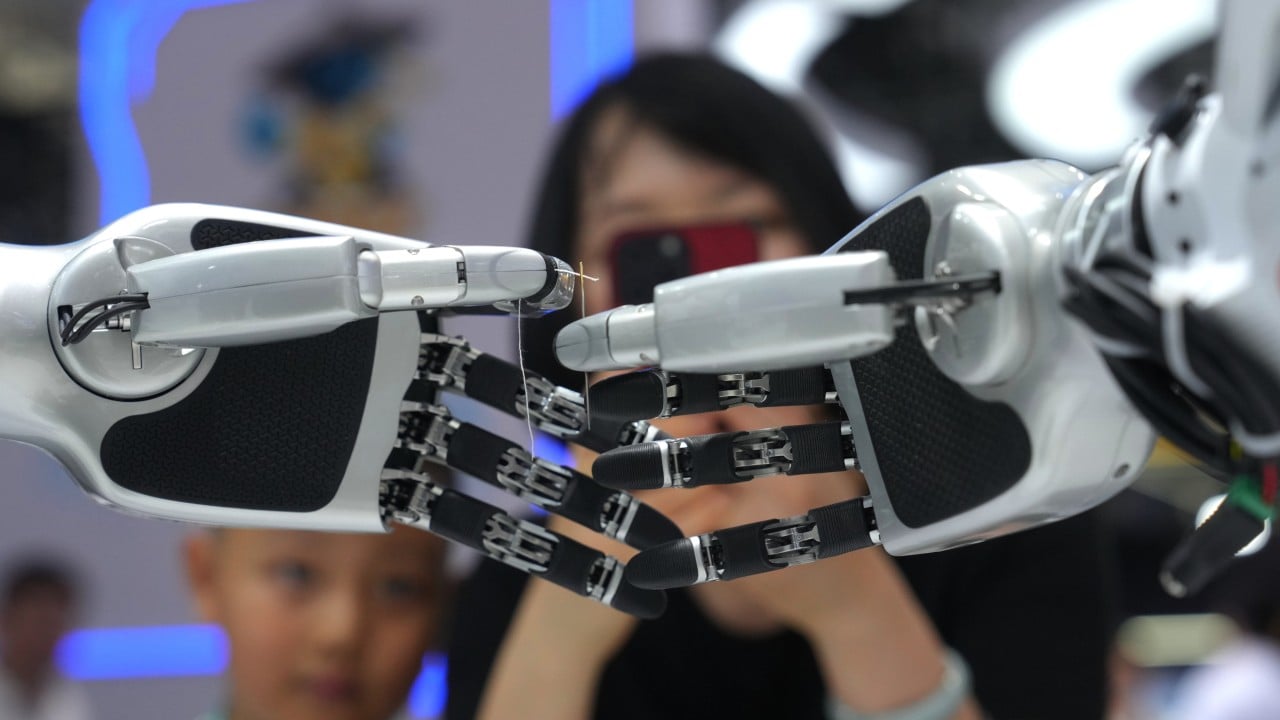
Humanoid robots still attracted crowds at this year's World Robot Conference (WRC) in Beijing, although other types of robots, including wheeled machines, were gaining traction as the industry moves from demonstrations to actual deployment. Unitree Robotics showcased bipedal models engaged in activities like table tennis and fighting matches, demonstrating advancements in speed, balance, and coordination.
However, other exhibits featured robots sorting parcels, loading production lines, or moving materials, with many of them utilizing wheels instead of legs or traditional robotic arms. Yang Li, senior engineer at start-up X Square Robot, questioned the necessity of bipedal robots when wheels could accomplish the task. During testing, Unitree's WALL-B robot sorted 1,816 packages in an hour, outperforming the bipedal Figure 03 robot from US-based Figure AI, which handled an average of 1,248 parcels per hour.
Meanwhile, AI2 Robotics displayed a wheeled robot making coffee and ice cream for conference attendees, employing different end effectors for various tasks. The company's vice-president and head of strategy, Mo Lei, noted that their robots had evolved from performing single demonstrations to handling multiple tasks for clients across various locations.
In industrial settings, the key question remains whether a robot can consistently perform for eight to 16 hours daily. Despite the shift towards non-humanoid robots, bipedal models still lead in shipment numbers in China, accounting for 50% of sales, followed by wheel-based humanoids at 29% and full-size bipeds at 21%. Nevertheless, wheeled platforms are rapidly gaining popularity in industrial and commercial applications due to their stability, making them practical for manipulation and embodied-AI applications.
The competition is also shifting from robot bodies to their "brains." Unitree founder Wang Xingxing highlighted that AI models represent the company's largest investment in terms of capital and personnel, with a portion earmarked for intelligent robot model research and development. Additionally, Unitree unveiled a seven-axis biomimetic robotic arm, R1, priced at 9,900 yuan (US$1,472).
Another challenge lies in data, as the increasing demand fuels the growth of relevant firms. Lumos Robotics, a robot maker, offers data-collection equipment and data-processing services, contributing roughly half of its revenue. The company collaborates with Mitsubishi Electric on a project involving assembly, packaging, material handling, and inspection at Mitsubishi's Chinese factories, emphasizing the significance of real-world data over the sheer number of robots purchased.
Written by urgent.news from SCMP Tech's reporting — not their text. Machine-written — may contain errors; check the original before relying on it.
This story
This is one outlet's version. Read the fullest account.
- Chinese robots tackle tennis, smash track records at World Humanoid Robot Games scmp.com
- Chinese humanoid robots smash human records in 100m sprint and high jump at Beijing robot games thehindu.com
- Chinese humanoid robot beats Bolt's 100-metre world record time euronews.com
- Chinese humanoid robots smash human records in 100m sprint and high jump qatar-tribune.com
- Chinese humanoid robots smash human records in 100m sprint and high jump at Beijing robot games mainichi.jp
- Robot horse and rider steal the spotlight at Chinese conference bbc.co.uk
- Chinese humanoid robots smash human records in 100m sprint and high jump at Beijing robot games winnipegfreepress.com
- Chinese robot sprints 100m faster than Usain Bolt: Why teaching robots to run matters indianexpress.com