This Star Whips Around the Milky Way’s Black Hole Faster and Closer Than Any Other Known Star
At 15,500 miles per second, it’s the fastest planet or star ever observed by science, but its true value is how close it is to our galaxy’s supermassive black hole.
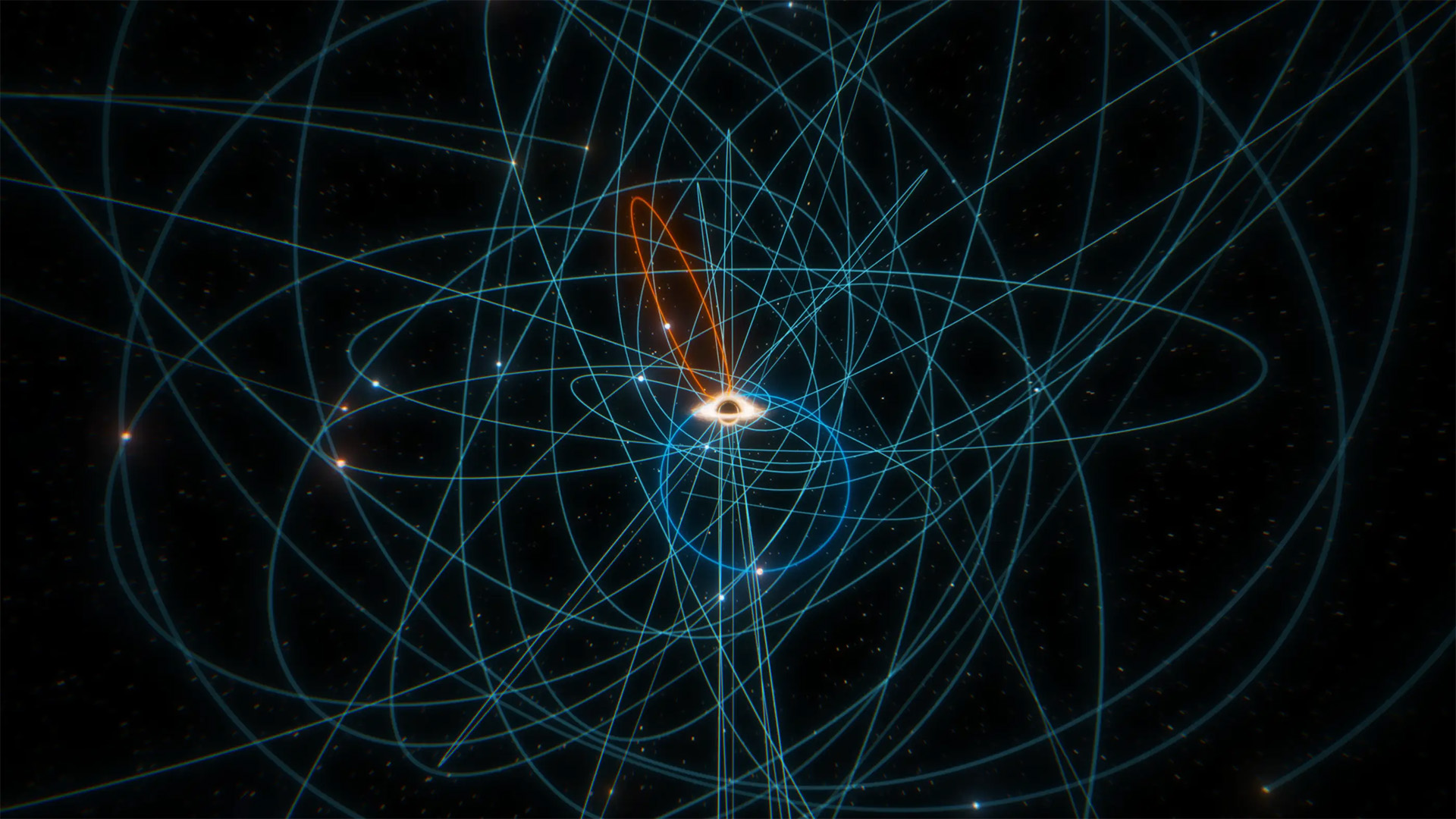
Researchers have discovered a star named S301 that orbits the Milky Way's supermassive black hole at an astonishing speed. S301, located near the center of our galaxy, was identified by scientists at the Max Planck Institute for Extraterrestrial Physics in Germany. This star is remarkable for its incredible velocity, reaching speeds of around 15,500 miles per second (55.8 million miles per hour) as it approaches the black hole.
Prior to this, the previous record-holder for the fastest-moving celestial object was a low-mass star and its accompanying planet, which traveled at approximately 1.2 million mph (333 mps).
What makes S301 particularly intriguing is its proximity to Sagittarius A*, the supermassive black hole at the heart of the Milky Way. It orbits at a distance ten times closer to the black hole than the previous closest star, S2, allowing the star to experience the effects of the black hole more acutely. S301's unique characteristics and its close orbit provide researchers with an unprecedented opportunity to study the behavior of stars near supermassive black holes.
By observing S301 over the next decade, researchers hope to gain insights into the workings of black holes. One of the key aspects they aim to investigate is frame-dragging, or the Lense-Thirring effect, a prediction of Albert Einstein's general relativity theory. This effect occurs when massive rotating objects, such as supermassive black holes, twist the fabric of spacetime around them, creating a rotating wave that can interact with nearby objects.
S301, being so close to Sagittarius A*, is the first star to directly experience this extreme frame-dragging effect, making it an invaluable target for studying this phenomenon.
Written by urgent.news from CNET's reporting — not their text. Machine-written — may contain errors; check the original before relying on it.