Western Railway Intensifies Food Safety And Water Quality Checks; 98 Per Cent Food And 99.87 Pc Water Samples Pass
Mumbai, August 19, 2026: Western Railway’s (WR) medical department inspected nearly 1,000 food samples since April and recorded an overall fitness rate of roughly 98%. It has also received 64 ‘Eat Right’ certifications for 51 railway stations and 13 campuses across the zone. The Western zone of Indian Railways has executed an extensive, multi-divisional monitoring drive targeting food quality,…
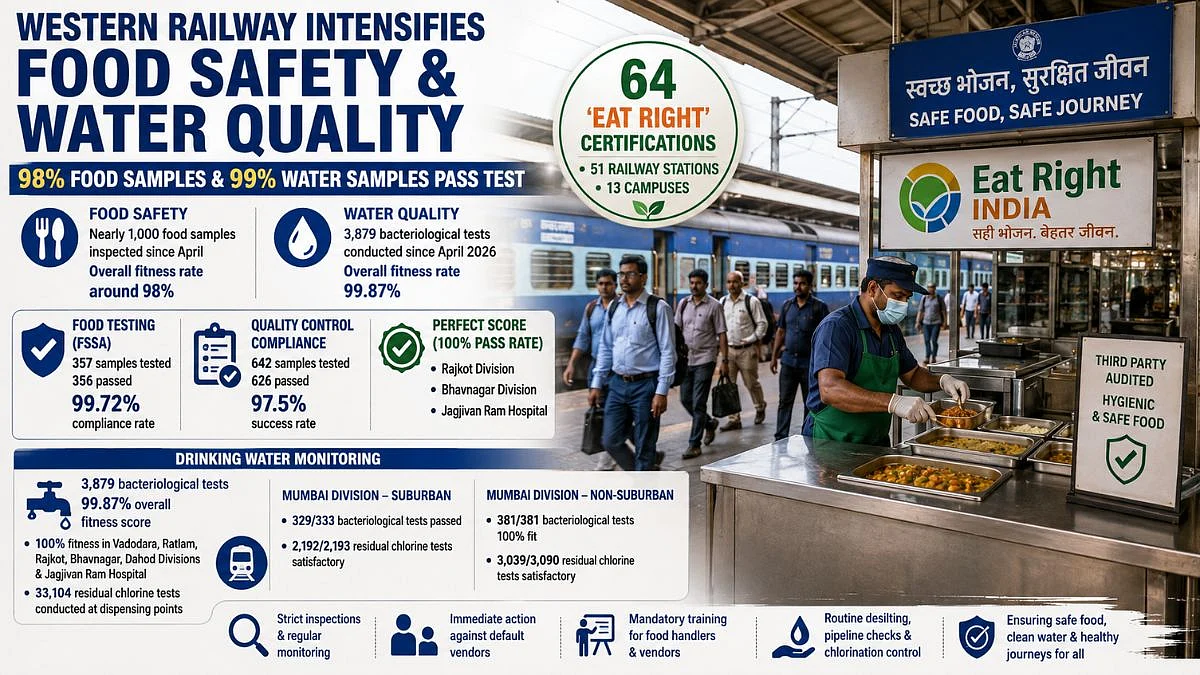
Mumbai, August 19, 2026: Western Railway (WR) intensified scrutiny of food safety and water quality across its extensive network in April 2026. Inspections of nearly 1,000 food samples since April yielded a commendable 98% compliance rate, with 64 'Eat Right' certifications earned for 51 railway stations and 13 campuses. The railway zone has launched a thorough, multi-divisional monitoring campaign to bolster health standards and passenger confidence.
Food quality tests involved 357 samples under the Food Safety and Standards Act, 99.72% passing. Water quality assessments analyzed 642 samples, 97.5% passing. Rajkot, Bhavnagar, and Mumbai's Jagjivan Ram Hospital achieved perfect 100% pass rates. Non-compliant vendors face penalties and re-audits. WR's collaboration with FSSAI under Eat Right India achieved 64 certifications, focusing on training for catering staff and base kitchen handlers.
Drinking water surveillance covered 3,879 bacteriological tests, 99.87% fitness, and 381 residual chlorine tests, all satisfactory. Water monitoring in Mumbai Division differentiated between suburban and non-suburban stations, with 329 out of 333 bacteriological tests and 2,192 out of 2,193 chlorine tests meeting potable standards.
Written by urgent.news from Free Press Journal's reporting — not their text. Machine-written — may contain errors; check the original before relying on it.