From spectacle to scale: why China’s robotics firms face a ‘critical juncture’
At China’s annual World Robot Conference (WRC) that kicked off on Wednesday, the hall was filled with humanoid robots wowing visitors with feats of dexterity: from playing table tennis to performing drum solos. These eye-catching displays have helped China’s robotics industry win global attention – and raise huge amounts of capital – over the past couple of years. But at this year’s summit, the…
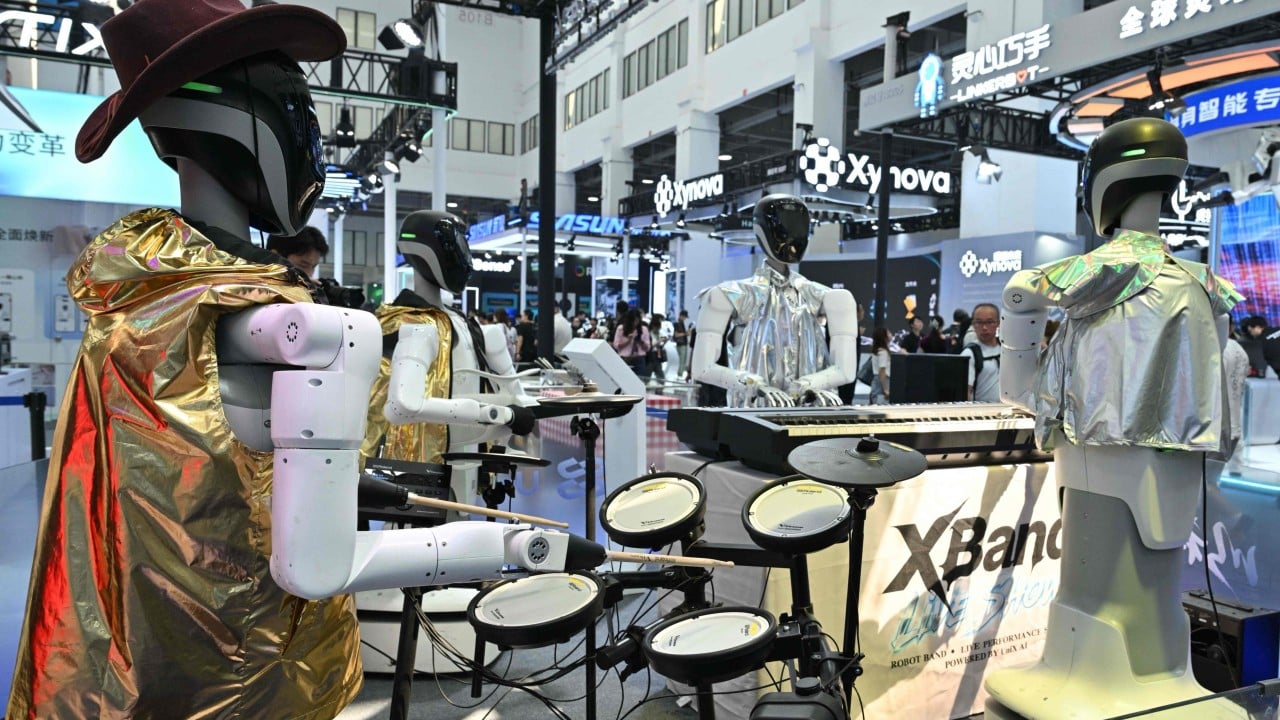
China’s annual World Robot Conference (WRC) commenced on Wednesday, showcasing impressive humanoid robots captivated attendees with their dexterous abilities. Despite the captivating demonstrations, executives, investors, and policymakers at this year’s summit expressed a pragmatic shift from viral stunts to scaling down robot applications to real-world scenarios.
Xu Xiaolan, president of the Chinese Institute of Electronics and a former vice-minister at China’s Ministry of Industry and Information Technology, acknowledged the industry at a "critical juncture" where the focus is on translating advancements into tangible benefits. China leads the world in manufacturing humanoid robots, accounting for 97% of global shipments in the first half of the year, with production expected to soar from 12,000 units to 50,000 by 2026 and 446,000 by 2030.
The transition to mass production will redefine competition as firms strive for robots that offer reliability, autonomy, and economic value in practical environments instead of merely impressive locomotion. The five-day event in Beijing, hosting over 300 robotics companies (a 36% increase from last year), marked the debut of Unitree Robotics, a leading player whose shares skyrocketed by 460% on its first day of trading.
However, challenges persist, with major manufacturers grappling with costs and profitability. A recent survey revealed that 62% of firms plan to adopt humanoids between 2025 and 2027, yet only 23% are content with current offerings, highlighting the need for enhancing reliability, functionality, and affordability. Government initiatives are also bolstering the industry, with 49 state-owned enterprises participating in this year’s conference and a central SOE robot innovation consortium set to foster joint technology development and commercialization.
Amidst growing political tensions with the US, the conference underscored the importance of global collaboration, launching a "Global Robot Application Exploration Programme" to distribute mass-produced robots to overseas innovation teams for testing. Xu emphasized the necessity of an open, collaborative, and mutually beneficial industry ecosystem, emphasizing the need for international cooperation to overcome obstacles in components, software, algorithms, data, manufacturing, and applications.
Written by urgent.news from SCMP Tech's reporting — not their text. Machine-written — may contain errors; check the original before relying on it.
This story
This is one outlet's version. Read the fullest account.