Urgent.News

What's breaking now, across thousands of outlets.

Science

China’s Landspace recovers booster with second orbital launch of Zhuque-3 rocket

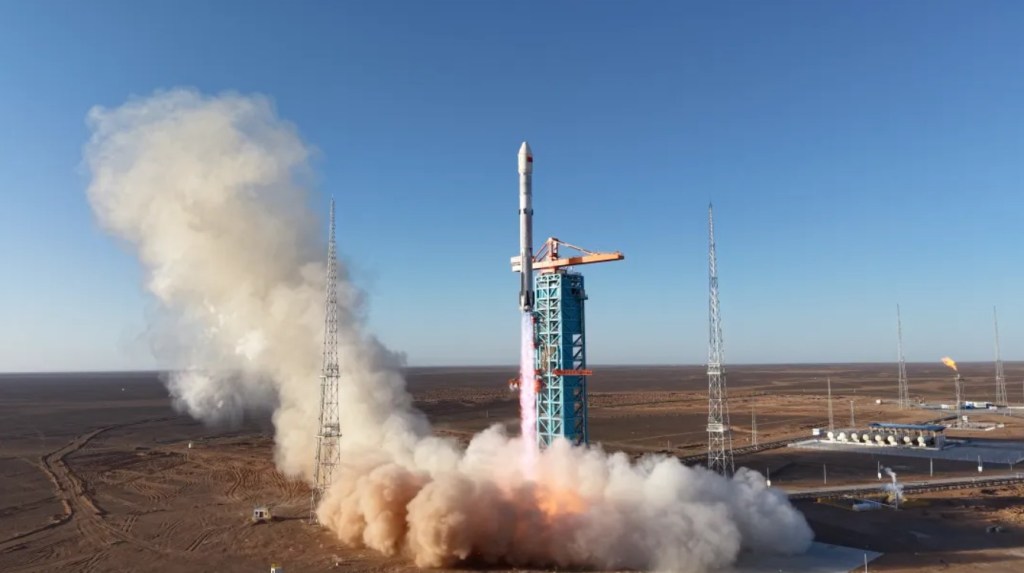
HELSINKI — Landspace successfully landed the first stage of its Zhuque-3 rocket Tuesday following the second launch of the rocket from the Gobi Desert. The second Zhuque-3 rocket lifted off […] The post China’s Landspace recovers booster with second orbital launch of Zhuque-3 rocket appeared first on SpaceNews .
China’s Landspace recovers booster with second orbital launch of Zhuque-3 rocket

China's Landspace successfully launched its Zhuque-3 rocket for the second time, with the rocket lifting off from the Jiuquan Satellite Launch Centre in the Gobi Desert. According to Reuters Business via SCMP, the launch occurred at 7:35am on Wednesday. The 66-metre rocket delivered a Honghu-3 internet satellite into its designated orbit.

The first stage of the Zhuque-3 rocket was recovered, marking a major milestone for Landspace as China's first commercial rocket to both reach orbit and have its first stage recovered. This achievement also makes Landspace the fourth entity to recover a launch vehicle, following US companies SpaceX and Blue Origin, and the state-owned China Aerospace Science and Technology Corporation.

The Zhuque-3 rocket is powered by liquid methane and oxygen. Reuters Business via SCMP and South China Morning Post reported that during its maiden flight in December, the second stage successfully reached orbit, but the first stage did not recover successfully. The first stage returned to Earth and touched down vertically at a recovery site in Minqin county, Gansu province.

Brief written by urgent.news from SpaceNews, Reuters Business via SCMP, South China Morning Post, Arabian Business — 4 reports on this story. Machine-written — may contain errors; check the original before relying on it.

Also reported by 1 other outlet

Read the original at spacenews.com →

More in Science

China successfully recovered its second reusable rocket in just one month, intensifying its pursuit of the United States in the space race. The state-owned China Aerospace Science and Industry Corporation (CASIC) announced on April 27 that it had successfully recovered a reusable rocket, the "Zhuque-2", which was launched on April 25 from the Jiuquan Satellite Launch Center in Gansu Province. CASIC said that after the rocket reached an altitude of 350 kilometers and completed its mission, it successfully re-entered the atmosphere and landed back on Earth. The recovery of the Zhuque-2 rocket comes just a month after China's first reusable rocket, the "Zhuque-1", was successfully recovered on March 30. China's rapid progress in reusable rocket technology has raised expectations that it will be able to launch satellites and other spacecraft at a lower cost. The United States has been a leader in reusable rocket technology, with companies such as SpaceX and Blue Origin making significant advancements in recent years. However, with China's latest success, the country is now closing the gap with the United States in the space race. China's space program has made significant strides in recent years, with several notable achievements, including landing a rover on the far side of the Moon and launching a lunar probe. The country's space agency, the China National Space Administration (CNSA), has set ambitious goals for its space program, including sending humans to the Moon by 2030 and establishing a permanent human presence on the lunar surface. With its reusable rocket technology, China is expected to play a major role in the global space industry in the coming years. Analysts say that China's success in reusable rocket technology will have significant implications for the global space industry, as it will provide a more cost-effective option for launching satellites and other spacecraft. The development of reusable rockets is a key area of focus for the global space industry, as it has the potential to significantly reduce the cost of accessing space. China's progress in this area is likely to put pressure on other space-faring nations to accelerate their own development of reusable rocket technology. The country's success is also expected to inspire other countries to pursue their own space programs, which could lead to a new era of space exploration and development.

More from Wednesday 19 August →