Aufschwung mit Nebenwirkungen: So profitieren Chinesen und Wohlhabende von der deutschen E-Auto-Prämie
Seit Januar fördert der Staat private Käufer von Batterieautos mit insgesamt drei Milliarden Euro. Nicht jede Prämie erreicht ein erwünschtes Ziel. Und es wachsen die Zweifel, ob die Hilfe nötig ist.
Since January, the government has been subsidizing private purchases of electric vehicles with a total budget of three billion Euros. Not every subsidy reaches its intended goal, and doubts are growing about whether the assistance is necessary. Carsten Schneider expressed genuine enthusiasm, praising the attractive new electric cars from German manufacturers.
To convince even previously hesitant consumers, the SPD politician introduced a new subsidy with a budget of three billion Euros. The aim is to drive the drive technology forward and help both the struggling industry and climate protection. Car buyers can now apply for the subsidy for all newly licensed electric vehicles since January, but technical possibilities only became available since mid-May.
Recent figures show that the subsidy is now attracting consumers, but raise doubts about whether it primarily helps lower-income households and German manufacturers. The ministry responsible for the subsidy has approved about 37,000 applications and paid out 162 million Euros. While the three billion Euro budget is far from being exhausted, the program is seen as a success in government circles.
The number of new electric vehicle registrations has increased by over 50 percent compared to the previous year from January to July, with a market share of over 25 percent. The boom was also due to unusually high discounts from many manufacturers, which responded to EU directives on reducing average fleet emissions. By selling more battery-powered cars, manufacturers can lower average values and avoid paying fines to the EU.
The subsidy can make it possible for less wealthy households to buy an electric car. To prevent subsidizing buyers who don't need assistance, the government has made the subsidy tiered based on income and number of children. A statistic published in early August suggests that the subsidy has achieved its goal, with roughly half of the subsidized households earning less than 45,000 Euros.
However, it also appears that the wealthy have used the subsidy, including models from Porsche, Mercedes, and BMW costing over 100,000 Euros. Some politicians are already calling for a price ceiling, arguing that luxury cars shouldn't be subsidized by the state. The environmental ministry remains reluctant to impose price caps, stressing that they are against market-distorting measures.
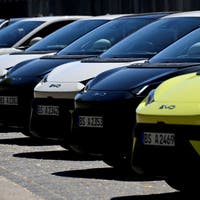
The subsidy's impact on high-priced cars only affects a few isolated cases, according to the industry association VDA. Critics also point out the promotion of Chinese manufacturers, whose sales have surged this year. BYD's registrations increased to around 31,000 in the January-July period, while Leapmotor and Xpeng saw their numbers rise from 2,700 to over 11,000 and 1,300 to 4,600, respectively.
The subsidy's effect is, however, modest, benefiting around 1,700 BYD and 1,300 Leapmotor buyers according to the Bafa statistics. Notably, the subsidy does not cover Chinese producers as much as it does others. German companies, too, benefit from the subsidy, producing electric cars for the German market in China, with BMW manufacturing the electric Cooper and Aceman models in cooperation with Great Wall Motors in a Chinese factory.
Models from other German manufacturers are also being produced in Chinese plants. For these models, a subsidy would no longer be possible in Germany. According to Ferdinand Dudenhöffer, the CEO of the CAR Institute in Bochum, the subsidy is unnecessary and has never been needed. He believes that a greater variety of small and compact electric cars has fueled demand for electric vehicles, along with discounts and high fuel prices.
The market is developing even without state support, "piece by piece upward." Even Burkhard Weller sees the subsidy as double-edged. "Its effect is to push the purchase of electric vehicles," he says, adding that once the subsidy runs out, consumer reluctance will become more apparent. The association recommends ensuring that young used cars are included in the subsidy program.
This would benefit not only young buyers but also reduce the decreasing value of existing electric cars, which could encourage more purchases.
Written by urgent.news from NZZ Wirtschaft's reporting — not their text. Machine-written — may contain errors; check the original before relying on it.