Indiens Autofahrer revoltieren gegen den Biotreibstoff E20 – sie fürchten Schäden am Motor und eine geringere Reichweite
Die indische Regierung bewirbt die Einführung des Benzin-Ethanol-Gemischs als Beitrag zum Kampf gegen den Klimawandel und zur wirtschaftlichen Autonomie des Landes. Auf den Strassen sind aber viele nicht überzeugt.
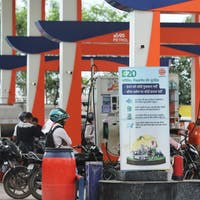
The Indian government is promoting the introduction of the gasoline-ethanol blend E20 as part of their effort to fight climate change and gain economic independence. However, many drivers are not convinced. Political decisions regarding gasoline and diesel are always sensitive, with fuel tax hikes having sparked protests in the past.
The nationwide rollout of E20 is now causing protests among drivers. The gasoline mixture with 20 percent ethanol aims to reduce dependence on oil imports and improve the climate balance according to the Indian government's plans. Drivers, however, claim that the high ethanol content damages engines and reduces driving range. The controversy surrounding the fuel has been simmering for some time and is putting the government in Delhi under increasing pressure.
Prime Minister Narendra Modi is already facing pressure after his Education Minister had to resign in July during a teaching entrance examination scandal. The E20 issue now has the potential to mobilize a larger portion of the population. Videos of angry drivers going viral. Opposition leader Rahul Gandhi accuses the government of imposing the unpopular fuel without giving people a choice to fill up with a different kind.
Leader of the Aam Aadmi Party Arvind Kejriwal led a protest march in Delhi, accusing Modi of acting under pressure from the US, which wanted India to buy more ethanol and genetically modified corn. The introduction of E20 has been a concession in ongoing trade talks. Since April, there has only been E20 at Indian gas stations. Pure gasoline and the previously sold E10 blend, which contains 10 percent ethanol, are no longer available.
The government argues that offering different gasoline types would be too complicated. Critics, however, point out that in Brazil, where ethanol has been widely available for decades, drivers have still been able to choose which blend they want to fill up with. In the media, reports are multiplying about the E20 mixture damaging older vehicle engines.
In fact, the higher ethanol content can attack rubber seals and other plastic parts at pumps, filters, and lines. For new vehicles, this is not an issue, as all new cars have been built to handle E20 since 2023. Drivers of older cars and motorcycles, which make up 77 percent of Indian gasoline vehicles, are forced to undergo expensive conversions.
Critics also argue that E20 is not as efficient as pure gasoline and that drivers therefore get fewer kilometers per tank fill-up. In fact, ethanol has a significantly lower calorific value. In this context, drivers are unhappy that E20 is sold almost at the same price as before E10 or pure gasoline. Other countries like Brazil, the US, or EU states offer biofuels much cheaper, point out the critics.
The government dismisses the criticism initially, denying that E20 offers less driving range and engine damage. Later it admits that problems could arise with older vehicles and that one could have a reduced range with E20. Nevertheless, it downplays the extent and points out that fuel consumption also depends on driving style, vehicle condition, and use of air conditioning.
The government instead emphasizes the benefits of E20. It reduces India's dependence on oil imports and thus lowers the need for foreign currency. India imports 80 percent of its oil, most of it from the Middle East, making it vulnerable to such dependence as shown by the Iran war and the Hormuz strait blockade. This dependence makes the economy vulnerable.
The government also claims that using biofuel improves the climate balance and contributes to the fight against air pollution, which has been a huge problem in cities like Delhi for years. Ethanol burns cleaner than pure gasoline, resulting in less particulate matter and other harmful emissions. It is also true that ethanol is less climate-damaging than fossil fuels, as it is derived from renewable raw materials such as sugarcane, rice, and corn.
Finally, the government stresses that the higher ethanol content benefits Indian farmers. Indeed, E20 has sparked a boom in ethanol production, with 45 percent coming from corn, 22 percent from rice, 16 percent from sugarcane, and 10 percent from molasses. Around 500 distilleries now produce 10.5 billion liters, with capacity up to 18-20 billion liters, prompting a demand for more ethanol.
Critics see this as a major driver for the E20 program. To meet the demand for corn, corn cultivation has expanded significantly, and India is now even importing corn. This leads to an increase in corn cultivation, with India now importing corn as well. Farmers receive the same price for their corn regardless of whether it is used for animal feed or ethanol production.
While the benefits of the increased ethanol demand for farmers are contested, what cannot be denied is that it has created a new market for corn. However, this has led to a conflict of interests, as the cultivation of crops for ethanol production competes with food production.
Written by urgent.news from NZZ Wirtschaft's reporting — not their text. Machine-written — may contain errors; check the original before relying on it.