The JWST Little Red Dots Could Be 'Black Hole Stars'
Little red dots have puzzled astronomers since their discovery in JWST data from the Universe’s deep past. Their ‘powering engines’ might resemble a newly discovered phenomenon dubbed a “black hole star”—an early, rapidly growing black hole wrapped in dense gas. This object, described in a study published today in Nature by researchers at the Institute of Science and Technology Austria (ISTA) and…
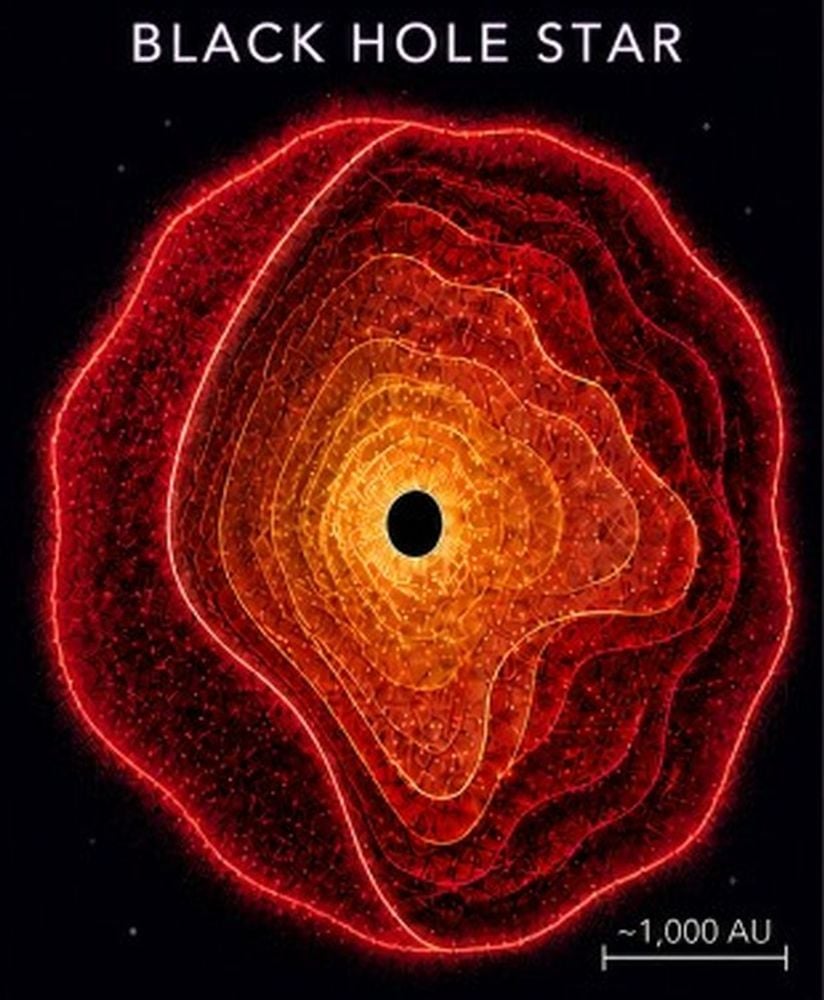
The early Universe's Little Red Dots (LRDs) may have been the JWST's most intriguing discovery. These small, red astronomical objects emerged between 600 million and 1.6 billion years after the Big Bang, and their existence has challenged our understanding of galaxy and supermassive black hole formation. Researchers have long debated what LRDs are, with some suggesting they could be early Active Galactic Nuclei (AGN) containing SMBHs, low-metallicity Population III stars, or entirely new types of stars.
However, none of these hypotheses fully explained the observations. New research in Nature proposes that LRDs might be black holes enveloped in dense gas, dubbed "black hole stars." This theory could explain the existence of SMBHs in the early Universe that are far larger than previously thought. The study focuses on MoM-BH*-1, an object discovered in the JWST's Ultra Deep Survey (UDS) extragalactic field, which appeared to be the reddest source in the area.
Spectroscopic analysis of MoM-BH*-1 revealed unique features that strongly suggest it is a SMBH surrounded by a gaseous envelope, rather than a dusty accretion disk.
Written by urgent.news from Universe Today's reporting — not their text. Machine-written — may contain errors; check the original before relying on it.